




Solar panel sealing on a roof succeeds when the mounting detail sheds water, the seal maintains contact through movement, and every material is compatible with the roof covering. A weather-resistant rubber gasket alone cannot compensate for poor flashing, an uneven bearing surface, or a fixing that repeatedly loosens.
For project managers, the first decision is whether a proposed seal forms part of a proven roof attachment detail or is being asked to rescue an incomplete one. Establish the water path and expected movement before selecting compounds. That sequence helps prevent a low-cost material choice from creating an expensive, difficult-to-access repair beneath the array.
Start with the roof interface and the route water can take
The most consequential sealing locations are usually roof penetrations, mounting feet, cable entries, and interfaces where brackets bear against the roof covering. These locations perform different jobs. A compressed washer around a fastener, a penetration boot, and a pad beneath a support cannot be treated as interchangeable simply because all three contain rubber.
For an array mounted above an existing roof, distinguish the module frame from the roof’s waterproofing system. Water passing between modules should still reach a functioning roof drainage surface. Attempting to seal every module gap can obstruct drainage or interfere with the module manufacturer’s intended design. Building-integrated photovoltaic roofs require their own evaluated weatherproofing details.
On pitched roofs, attachment details should direct runoff over flashing and back onto the roof surface. On membrane roofs, penetrations need detailing compatible with the membrane system, including the specified connection to its waterproof layer. For standing-seam clamps or ballasted supports that avoid penetrations, attention shifts toward clamp suitability, membrane protection, load distribution, and unobstructed drainage.
Trace water beyond the visible mounting foot. Wind-driven rain may reach exposed joints from several directions, while narrow gaps can draw water beneath a bracket. A perimeter bead can also conceal a cavity that holds moisture. The detail should provide a clear drainage route without depending on an exposed bead to withstand every possible water path.
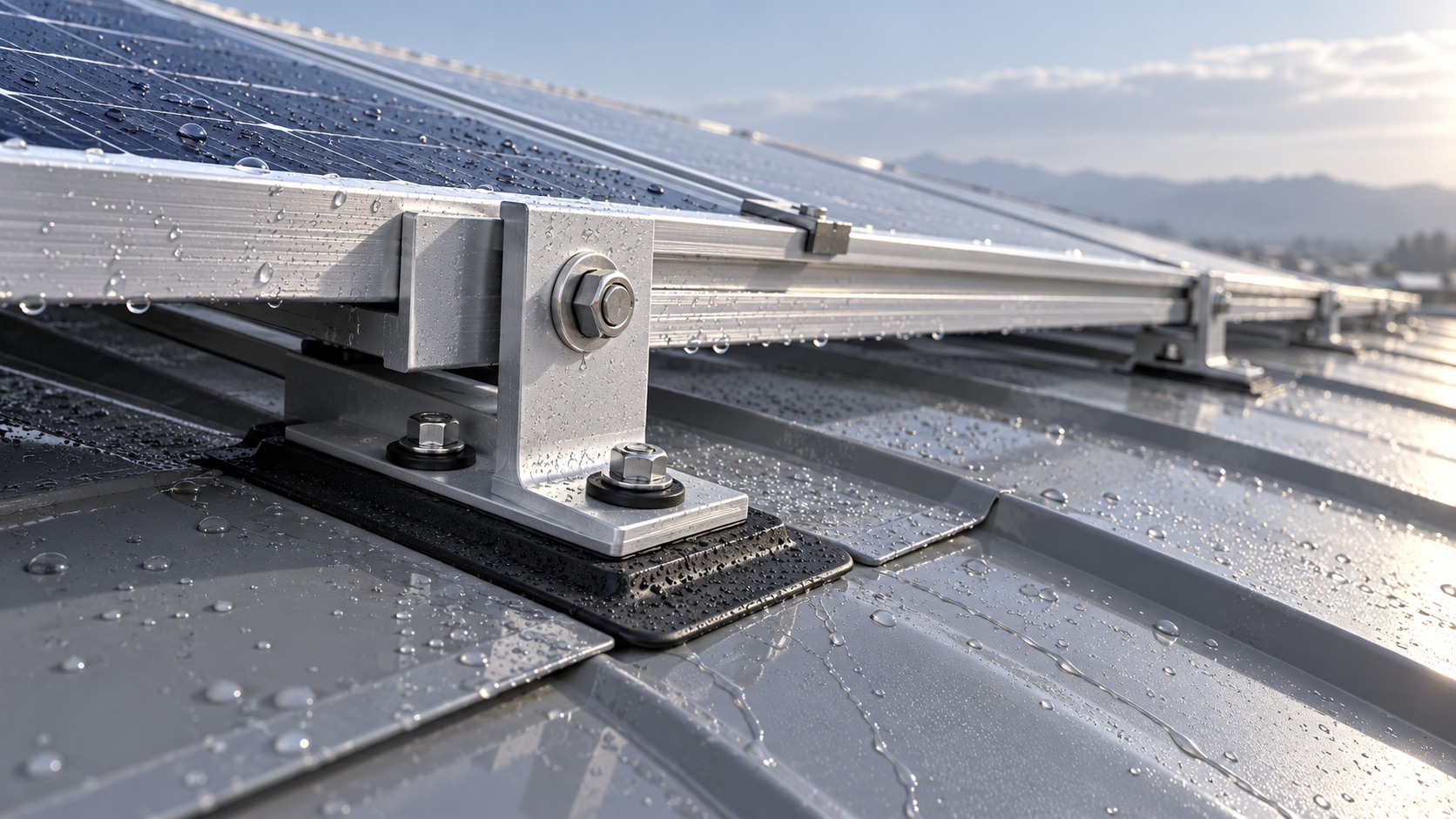
Before approving installation drawings, identify the primary water barrier at each attachment type and show how it connects to the roof. If that connection is unclear, choosing a more expensive sealant will not resolve the design gap.
Allow movement without losing sealing pressure
Modules, rails, brackets, fasteners, and roof coverings respond differently to temperature changes. Long rail sections can accumulate movement, while wind loading and roof deflection add repeated displacement. A seal that remains watertight immediately after installation may lose contact after these movements alter its compression or stress its bond.
For a gasket, specify the installed compression condition as well as the material. Too little compression leaves leakage paths across surface irregularities. Excessive compression can distort the gasket, force it out of position, or accelerate permanent deformation. Compression set matters because a gasket that fails to recover after prolonged loading may no longer follow a joint as it opens.
Fastener torque alone does not reliably establish gasket compression. Friction, washer geometry, substrate stiffness, and installer technique affect the result. Where the mounting design provides compression stops or a defined installed height, include those features in the inspection criteria. Tightening a leaking connection further can damage the roof covering or deform the sealing washer.
For sealants, the joint must have enough suitable geometry to accommodate the expected displacement. A thin smear beneath a moving bracket may experience concentrated shear. Where a joint is designed for a sealant bead, the specified depth, backing, and bond surfaces allow it to deform as intended. Adhesion to an unintended third surface can restrict that movement.
Keep structural restraint and sealing duties clear. Rail expansion provisions and attachment design should manage movement at the system level; the rubber or sealant accommodates the displacement assigned to its interface. It should not become the unintended restraint for an expanding rail.
Select the finished compound for the exposure
EPDM is a credible candidate for many outdoor sealing applications because suitably formulated compounds can offer good resistance to weathering, ozone, and water. However, the polymer name does not establish the performance of a finished gasket. Compound formulation, cure, geometry, manufacturing consistency, and compression conditions all influence service behavior.
Review the temperatures expected at the sealing location, including solar heating and cold-weather conditions. Air temperature alone is an incomplete basis for selection. Ask for evidence relevant to the finished component’s ability to retain useful elasticity, resist cracking, and maintain sealing force after aging under representative conditions.
Roof compatibility needs its own assessment. Membranes, coatings, asphalt-based materials, adhesives, cleaning agents, and rubber compounds may interact through migration, swelling, softening, or loss of adhesion. Approval for one roof system does not establish compatibility with another. Obtain acceptance from the roof-system supplier for the proposed interface, including primers and preparation methods where applicable.
Foam and solid rubber also serve different functions. A cellular strip may help conform to an irregular surface, but its ability to exclude water depends on cell structure, surface condition, compression, and recovery. The linked Air Conditioner Foam Strip illustrates a product category that should be assessed by its documented properties before consideration for a rooftop detail. An HVAC application name provides no evidence of suitability as a primary roof penetration seal.
Where reclaimed EPDM can fit
Properly formulated EPDM reclaimed rubber compounds may support economical sealing components when the finished product meets the application requirements. Their suitability should be assessed at compound and component level, with attention to feedstock consistency, processing, cure behavior, and performance after aging.
For project approval, request evidence for the proposed formulation and production component. Relevant properties can include compression set, hardness, tensile behavior, resistance to tearing around fixing holes, and dimensional stability. No single result proves watertightness. A material can retain acceptable tensile properties while losing too much sealing force in a compressed joint.
For a penetration with high repair consequences, place greater weight on assembly-level evidence under representative compression, movement, and water exposure. For a secondary cushioning pad, the priorities may differ, although roof compatibility and load behavior still need review. Reclaimed content is a formulation consideration; it does not independently establish or rule out suitability.
Make installation quality visible before the array hides it
Solar panel sealing deserves an inspection hold point before modules restrict access. At that stage, teams can still inspect flashing connections, gasket seating, cable-entry details, surface preparation, and drainage paths without dismantling installed equipment.
Use acceptance criteria that installers and inspectors can observe:
- Confirm that the attachment, gasket, and roof detail match the approved assembly, including component dimensions and specified materials.
- Check that sealing surfaces are sound and prepared as required, with no debris, folds, or misplaced gasket edges.
- Verify compression or tightening against the mounting instructions and check that brackets do not rock on uneven surfaces.
- Record sealant preparation, application conditions, and required curing time before exposing the detail to testing or service.
- Photograph completed waterproofing interfaces and record their locations before covering them with modules.
Where water testing is specified, agree on a method suited to the roof and attachment detail. Uncontrolled flooding or pressure washing can create misleading results or damage the assembly. A successful initial check should be considered alongside evidence of resistance to aging and movement.
For an existing leak, establish the entry route before adding sealant. Water can travel along a rail, beneath a membrane, or through the roof construction before appearing indoors. Repairing only the visible drip location can leave the original defect active and make later diagnosis harder.
Access belongs in the cost decision. A gasket that is inexpensive to buy may be costly to replace once rails and modules cover it. Approve the sealing detail with a documented repair route, compatible replacement materials, and clear responsibility for the roof interface. Those provisions give the maintenance team something more useful than an instruction to apply another bead when water appears.
Leave A Message
If you are interested in our products and want to know more details, please leave a message here, we will reply you as soon as we can.