




A door seal can pass heat-aging tests and still allow water into the cabin after months of compression, winter cold, and body movement. The rubber may retain acceptable tensile properties while the installed profile loses contact pressure at a corner. For quality control and safety teams, that gap between material performance and assembly behavior is where durability assessment becomes most important.
Evaluating Automotive Sealing System Durability therefore requires more than accelerated aging. It means connecting compound properties, profile geometry, installation tolerances, and service exposure to measurable acceptance criteria. This is particularly important when qualifying EPDM compounds, including formulations containing reclaimed rubber: neither material origin nor an aging report alone establishes fitness for a specific sealing application.
Start with the failure condition—not the aging temperature
Before choosing a standard, define what the seal must prevent and under which conditions. Water ingress around a door opening, dust penetration through a body aperture, and leakage from a fluid connection involve different loads, materials, and consequences. A validation plan should not treat them as interchangeable.
For an EPDM body seal, the working specification should identify:
- The installation envelope: minimum and maximum gap, compression range, corner geometry, joint design, and retention method.
- The exposure envelope: temperature extremes, sunlight, ozone, moisture, cleaning agents, and foreseeable road-chemical contact.
- The functional limits: permitted leakage, minimum sealing force, acceptable closing effort, and allowable movement or damage.
- The inspection state: whether measurements occur hot, cold, immediately after unloading, or after a defined recovery period.
These details prevent a common disagreement: the supplier reports a passing material result while the vehicle team observes a failing assembly. Both observations may be correct because they assess different things.
What the standards establish—and what they do not
Standardized methods make results reproducible and comparable. They generally do not provide universal automotive acceptance limits. The applicable OEM specification, component drawing, or agreed validation plan must supply those limits. Verify the current edition and any customer-specific modifications before commissioning tests.
A report stating “tested to ASTM” is incomplete without the method, conditions, specimen details, and results. Likewise, IATF 16949 certification concerns an automotive quality management system; it is not proof that a particular seal meets durability requirements. Material testing, component approval, and organizational certification answer different questions.
Automotive Sealing System Durability depends on retained force
Compression set is useful, but it is frequently asked to explain too much. It describes how well a specimen recovers its dimensions after compression. A seal, however, usually works while compressed, when the relevant question is whether sufficient force remains against the mating surface.
Compression stress relaxation complements compression-set testing. Evaluate force decay at application-relevant compression and temperature, then relate the result to the profile’s initial load-deflection behavior. A compound with acceptable recovery may still lose too much force during sustained loading.
Test production-representative profiles as well as standardized specimens. Hollow geometry, sponge density, extrusion direction, surface treatment, and local wall thickness can change the response. Include the least favorable permitted gap: a nominal installation may conceal inadequate contact at the largest assembly clearance.
Acceptance should consider both ends of the force window. Too little force risks leakage; too much may increase closing effort, distort the profile, or overload attachment features.
Recreate the sequence that makes a seal leak
Real exposure is cumulative. Heat can alter stiffness, cold can slow recovery, and repeated movement can damage a weakened surface. Separate tests help diagnose mechanisms, but selected sequential tests reveal interactions that isolated exposures can miss.
A practical component sequence might include baseline load-deflection and leakage measurements, compressed temperature cycling, repeated opening and closing, chemical exposure, and final leakage checks. The order should reflect credible service conditions rather than simply combining every available laboratory test.
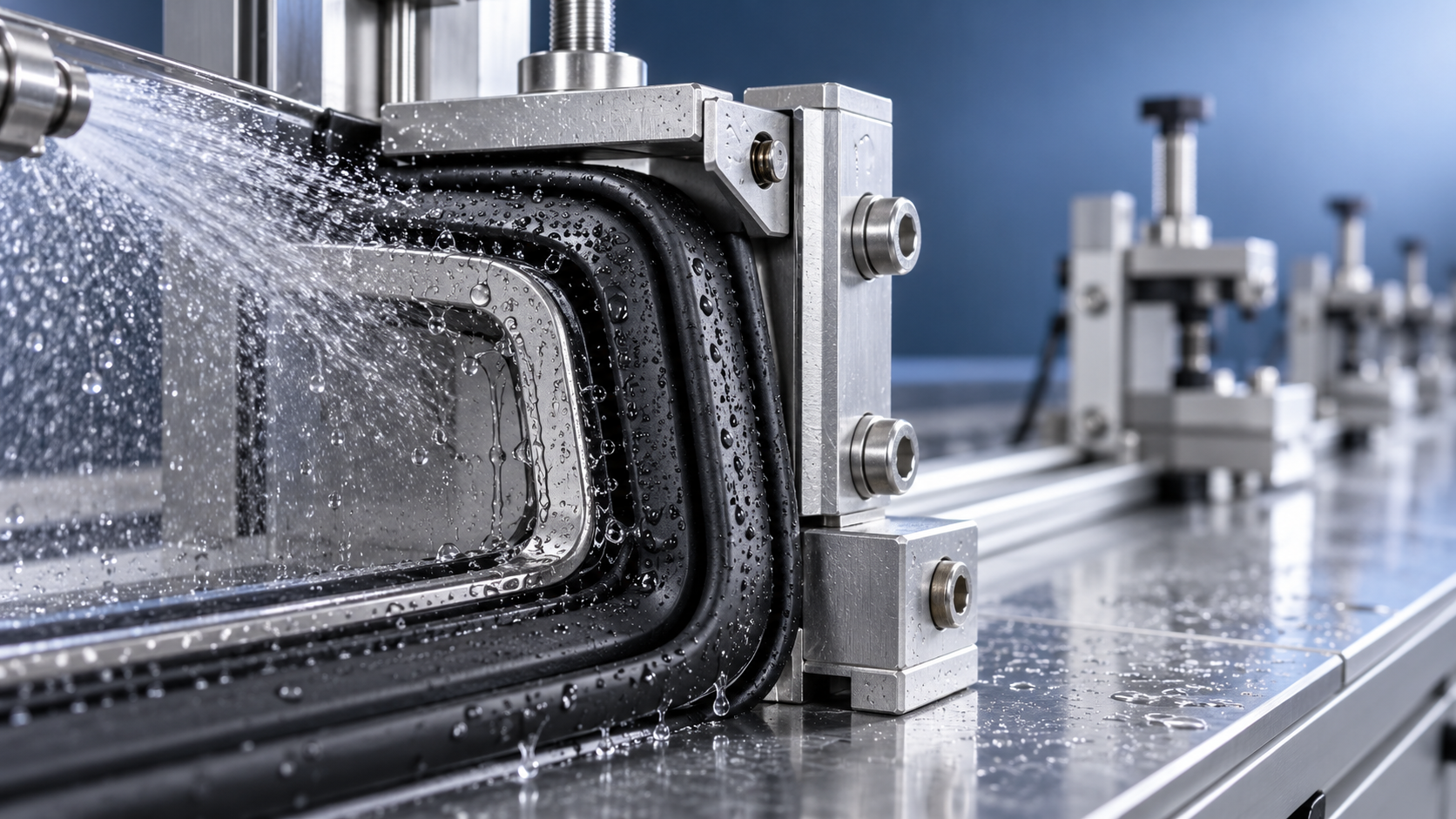
Temperature cycling under constraint
Cycle an installed profile across the specified temperature range while maintaining representative compression. Observe cold recovery, local lift-off, joint opening, and permanent distortion. Account for thermal expansion of the mounting structure, not just the rubber. Include stabilization periods sufficient for the test assembly to reach the intended temperature.
Movement, abrasion, and retention
Door cycling and application-relevant vibration or relative motion can expose profile migration, worn coatings, corner damage, and attachment weakness. Measure retention before and after conditioning where clips, carriers, or adhesives are involved. A durable compound cannot compensate for a profile that walks out of its channel.
Chemical exposure followed by functional testing
Choose fluids from the actual exposure assessment: washer fluid, de-icing solutions, cleaners, and incidental lubricants may be relevant. EPDM generally offers useful weathering resistance, but it should not be assumed compatible with petroleum oils or fuels. Check volume, hardness, and mechanical-property changes, then reassess sealing function where exposure could affect fit or force.
Leakage verification needs a representative fixture
A leak result is only meaningful when the fixture reproduces the important boundary conditions. Specify mating-surface geometry, fastening, profile joints, compression, pressure differential, water delivery, duration, and detection method. Check fixture leakage separately so it is not mistaken for seal failure—or allowed to obscure it.
Record where leakage begins, not merely whether the assembly passes. A repeatable corner leak suggests a different corrective action from distributed leakage along an under-compressed straight section. Photograph contact marks and inspect joints, splices, and transitions after testing.
Test at relevant intermediate stages when practical. An assembly that leaks when cold but reseals after warming may pass a room-temperature final inspection while still failing in service.
Qualifying EPDM compounds containing reclaimed rubber
Reclaimed EPDM should be evaluated as part of the finished formulation, not accepted or rejected solely by category. Its influence depends on feedstock consistency, processing history, incorporation level, the virgin polymer system, fillers, and cure chemistry. Qualification should therefore compare candidate compounds against an approved reference using equivalent processing and specimen preparation.
For purchasing and incoming quality control, agree on traceable material identification, relevant batch checks, change-notification requirements, and the evidence needed for requalification. Finished-compound checks may include cure behavior, hardness, tensile properties, compression response, and exposure resistance. Select controls according to the failure risks rather than relying on one convenient measurement.
Hebei Weizhong Rubber Technology has specialized in EPDM reclaimed rubber R&D, production, and sales since 1986. For automotive development, discussions with the material supplier should begin with the intended seal function and required validation evidence—not an assumption that one reclaimed grade suits every profile.
Related profile applications, such as Cold storage and garage door seals strips, also involve compression and temperature-management considerations. However, evidence from those applications does not establish automotive suitability; vehicle seals require their own compound and component qualification.
Release decisions should preserve the evidence chain
A defensible approval package links each failure mode to a test, each test to a defined limit, and each result to a traceable material batch and production condition. Include specimen count, conditioning, measurement uncertainty where relevant, deviations, and individual results—not just averages that can hide weak samples.
Accelerated aging remains valuable for screening and comparison. Service-life claims, however, require a validated relationship to field behavior; a fixed exposure should not automatically be translated into years of use. The stronger release decision combines material stability, retained sealing force, representative assembly testing, and leakage performance under the conditions that matter.
Leave A Message
If you are interested in our products and want to know more details, please leave a message here, we will reply you as soon as we can.