




A bridge joint can look sound from the roadway while leaking onto bearings below. It can also remain watertight yet create recurring problems when heavy traffic strikes an uneven joint edge. Bridge expansion seals therefore need to be assessed as part of a complete joint system—not simply as rubber profiles selected to fill a gap.
For project managers, the decision involves movement capacity, traffic loading, drainage continuity, installation conditions, and future access. Rubber formulation matters, but even a suitable compound cannot compensate for an incorrectly sized opening or a poorly detailed termination. A useful selection process starts with the bridge’s operating conditions, then works toward the seal design and its material requirements.
Define the movement envelope before comparing products
The visible joint opening during a site visit is only one point in a changing range. Thermal expansion and contraction influence that range, but creep, shrinkage, bearing behavior, and structural rotation may also matter. On skewed bridges, movement can include a significant component along the joint rather than only perpendicular to it.
Ask the bridge designer to establish the minimum and maximum openings, the installation setting at the expected structure temperature, and any transverse or vertical displacement requirements. Air temperature alone may not represent the bridge’s actual thermal condition.
One common procurement mistake is treating a stated movement capacity as a universal suitability rating. A seal might accommodate the required opening change yet be unsuitable for the joint skew, recess geometry, or expected rotation. Compare the complete operating envelope against the manufacturer’s approved design limits.
These are screening categories, not interchangeable specifications. Exact capacities depend on the approved system, geometry, material, and governing bridge-owner requirements.
Traffic changes what “suitable” means
Traffic volume is only part of the loading picture. Heavy vehicles, braking near intersections, wheel paths, roadway curvature, and uneven approaches can increase demands on the joint assembly. A seal should accommodate movement while the surrounding system transfers traffic loads as designed.
For many strip seal and modular systems, metallic components and their anchorage carry wheel loads; the elastomeric gland provides the flexible water barrier. That distinction matters when reviewing proposals. A tougher rubber compound is not a remedy for inadequate anchorage, damaged headers, or incorrect rail elevation.
- Check the wheel-path interface: Confirm that joint edges, transition concrete, and riding-surface levels will not create avoidable impact.
- Review heavy-vehicle exposure: Evaluate the complete assembly against the specified traffic and fatigue requirements.
- Consider debris: Stones and compacted sediment can obstruct movement or damage a seal as the joint closes.
- Include local operating conditions: Snowplows, maintenance equipment, and pavement resurfacing can affect detailing and long-term performance.
Where complaints about noise or ride quality are likely, evaluate those requirements during system selection rather than leaving them for construction-stage adjustment.
Follow the water beyond the joint opening
A watertight section across the carriageway does not guarantee a watertight installation. Leakage often develops at curb transitions, parapets, field splices, or connections between different details. Review the water path across the entire deck width, including sidewalks and edge drainage.
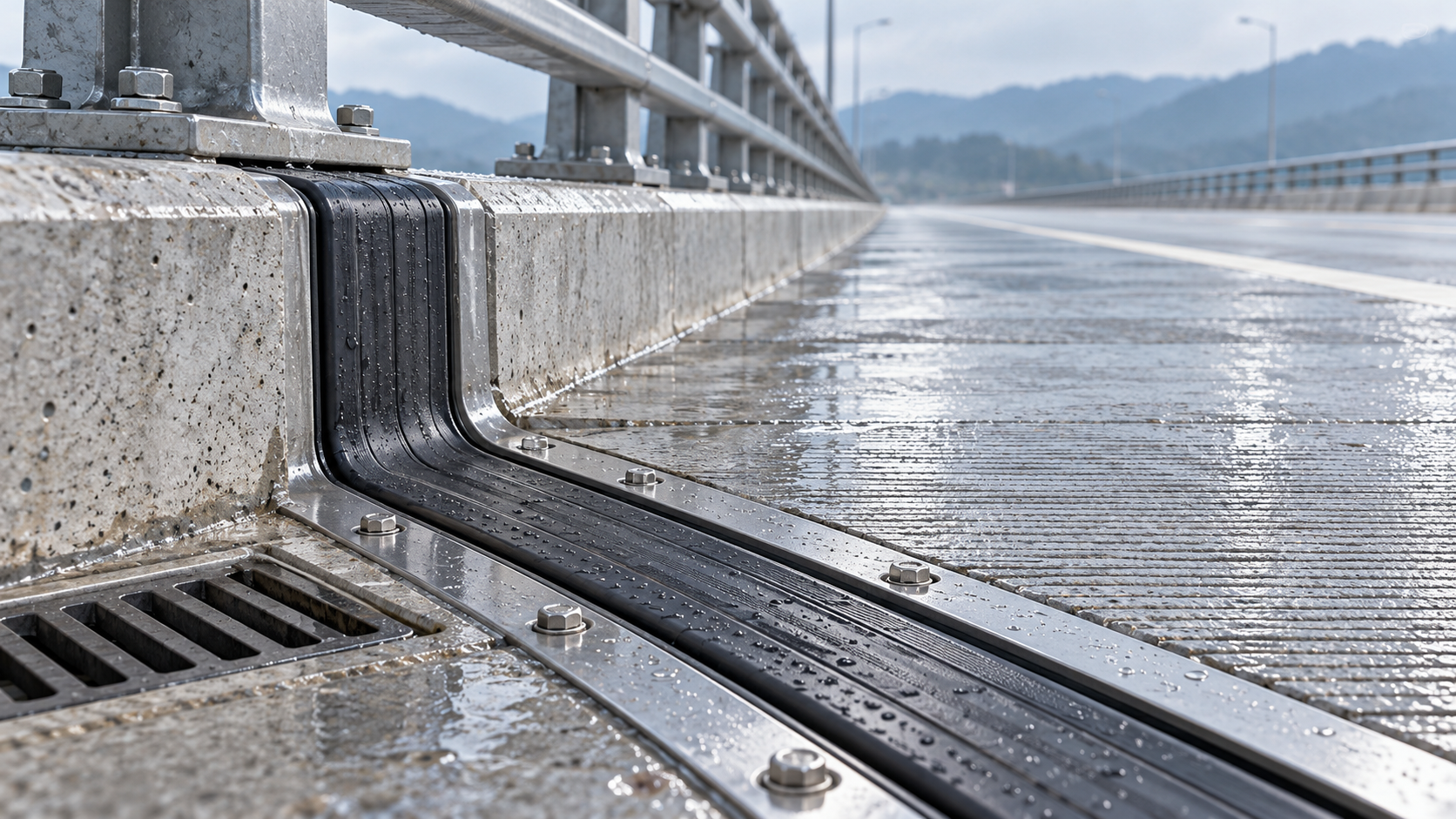
For a sealed joint, drawings should show how the seal turns up or terminates at the edges without leaving a bypass route. For a joint with a collection trough, the trough needs sufficient movement allowance, accessible outlets, and a discharge route that avoids vulnerable bearings and substructure components.
Drainage details also need to survive maintenance reality. An outlet that works on a clean drawing may block with grit or leaves. Ask how crews will inspect and clean it, whether traffic closures are necessary, and what happens if the primary discharge becomes obstructed.
A useful review question: If water enters at the least accessible end of the joint, where does it go? If the answer is unclear, the drainage design is not yet ready for procurement.
What rubber specifications should actually establish
EPDM is widely used in outdoor sealing because of its resistance to ozone and weathering. Nevertheless, polymer identification alone does not establish whether a finished profile is suitable for a bridge joint. Compound formulation, curing, dimensional control, and compatibility with the retention system all influence performance.
Specify the tests, acceptance limits, conditioning procedures, and documentation required by the applicable project standard. Relevant properties may include tensile strength, elongation, hardness, compression set, heat-aging behavior, ozone resistance, and low-temperature flexibility. Their importance varies with the seal design; no single property should become a substitute for system qualification.
Exposure also deserves attention. EPDM is not generally selected for resistance to petroleum oils and fuels. Where recurring contamination is credible, require a material-compatibility assessment rather than assuming outdoor durability covers every chemical exposure.
The difference between applications is important when browsing supplier catalogs. A product such as Car Sealing Strips-EPDM concerns a different sealing duty and should not be treated as a bridge-qualified alternative. Bridge procurement requires evidence for the specified profile and joint system, not merely familiarity with EPDM products.
Where reclaimed EPDM enters the discussion
Reclaimed EPDM can be considered as a formulation ingredient where the specification permits it. Its acceptability depends on source consistency, processing, dosage, and the resulting compound’s verified properties. It should never be assumed equivalent to virgin EPDM, nor rejected or approved solely by its label.
Hebei Weizhong Rubber Technology, based in Xingtai, has specialized in EPDM reclaimed rubber research, production, and sales since 1986. For seal manufacturers evaluating reclaimed material, the relevant discussion is about feedstock consistency, processing behavior, and compound-development requirements. Material supply experience does not itself establish approval for a finished bridge seal; that remains a separate qualification exercise.
Use procurement to remove installation and maintenance uncertainty
The lowest seal price can become an expensive choice if replacement requires difficult lane closures or proprietary components with uncertain availability. Compare lifecycle implications alongside initial supply and installation costs.
Before approving a system, request a coordinated submission covering:
- Design compatibility: Movement calculations, opening limits, skew restrictions, and installation settings.
- Material evidence: Applicable test reports, batch traceability, dimensional tolerances, and agreed change-control procedures.
- Installation controls: Substrate preparation, rail alignment, splice methods, adhesive requirements where applicable, and inspection hold points.
- Water management: Edge terminations, troughs where used, outlet routing, and the specified leakage-check procedure.
- Maintenance planning: Inspection access, cleaning methods, replacement steps, and spare-profile availability.
For rehabilitation projects, verify existing recess dimensions and substrate condition before ordering. Site measurements may reveal damaged concrete, misaligned rails, or restricted access that changes the practical choice.
Ultimately, bridge expansion seals should be selected through three connected checks: can the system accommodate the full movement envelope, can the assembly withstand the traffic environment, and can water be controlled throughout its service life? Once those answers are supported by drawings and evidence, material and commercial comparisons become far more meaningful—and the project team has a clearer basis for approval.
Leave A Message
If you are interested in our products and want to know more details, please leave a message here, we will reply you as soon as we can.