




A full car door seal assembly is worth buying when its higher purchase price is offset by lower installation effort, more reliable fitment, or fewer repeat repairs. A replacement weatherstrip is the better value when the mounting structure remains sound and the correct profile is available. Compare the total installed cost of each option before choosing: a cheaper strip becomes expensive if it requires extensive fitting or fails to stop the original leak.
There is no dependable universal replacement price without the vehicle details, seal location, parts specification, and local labor rate. The useful comparison starts with two quotations covering the same repair scope, including removal, installation, associated hardware, and verification.
Establish what “full assembly” includes
The term full assembly is not a consistent parts description. It might identify a continuous weatherstrip with molded corners and attachment clips, a seal bonded to a carrier, or a larger trim component incorporating sealing elements. It does not automatically mean a complete door. Request a component breakdown or drawing before comparing prices.
Also identify the seal responsible for the complaint. The perimeter weatherstrip, glass run channel, and beltline seal perform different jobs. Replacing a perimeter seal will not resolve water entering through a damaged inner door membrane. A beltline strip helps manage water at the glass, but the door still relies on its internal drainage path.
The cost comparison needs a repair boundary
Calculate each option using the same basis:
Total installed cost = part price + installation labor + consumables and hardware + necessary adjustment and verification.
Record repeat-repair exposure separately unless there is credible service history supporting a numerical allowance. Relevant consequences include another workshop visit, additional transport, and vehicle downtime. Assigning an invented failure probability creates a precise-looking calculation without a reliable foundation.
A full assembly earns its premium when it eliminates work that the cheaper option actually requires. Molded corners can remove difficult cutting and joining operations. An integrated carrier can replace a distorted mounting component at the same time. Supplied retainers reduce uncertainty over whether old clips will survive removal. These advantages have value only when they address the condition of the door being repaired.
Compare labor scope carefully. One quotation may include removing old adhesive and testing for leaks, while another covers only fitting the new part. Freight, taxes, and return charges should also be treated consistently. A lower quoted total is not comparable if essential operations remain excluded.
Locate the fault before ordering the rubber
Wind noise, water entry, and excessive closing effort can point to different faults. A flattened sealing bulb suggests lost recovery, while a torn section indicates local damage. However, an uneven gap around the door can result from hinge wear, striker position, or previous body repairs. A new seal will not correct the underlying geometry.
Inspect the contact path around the opening, especially corners, joints, and transitions between attachment methods. A controlled paper-drag comparison at several positions can reveal uneven contact, although it does not establish waterproofing by itself. Leak testing should isolate areas progressively; indiscriminate high-pressure spraying can create misleading results.
Water appearing near the sill deserves particular attention. Trace the entry route before assuming the nearest visible seal has failed. Blocked drains or a detached inner membrane can send water into the cabin even when the perimeter weatherstrip makes adequate contact. Correcting that fault changes the purchasing decision entirely.
Where a full assembly justifies the premium
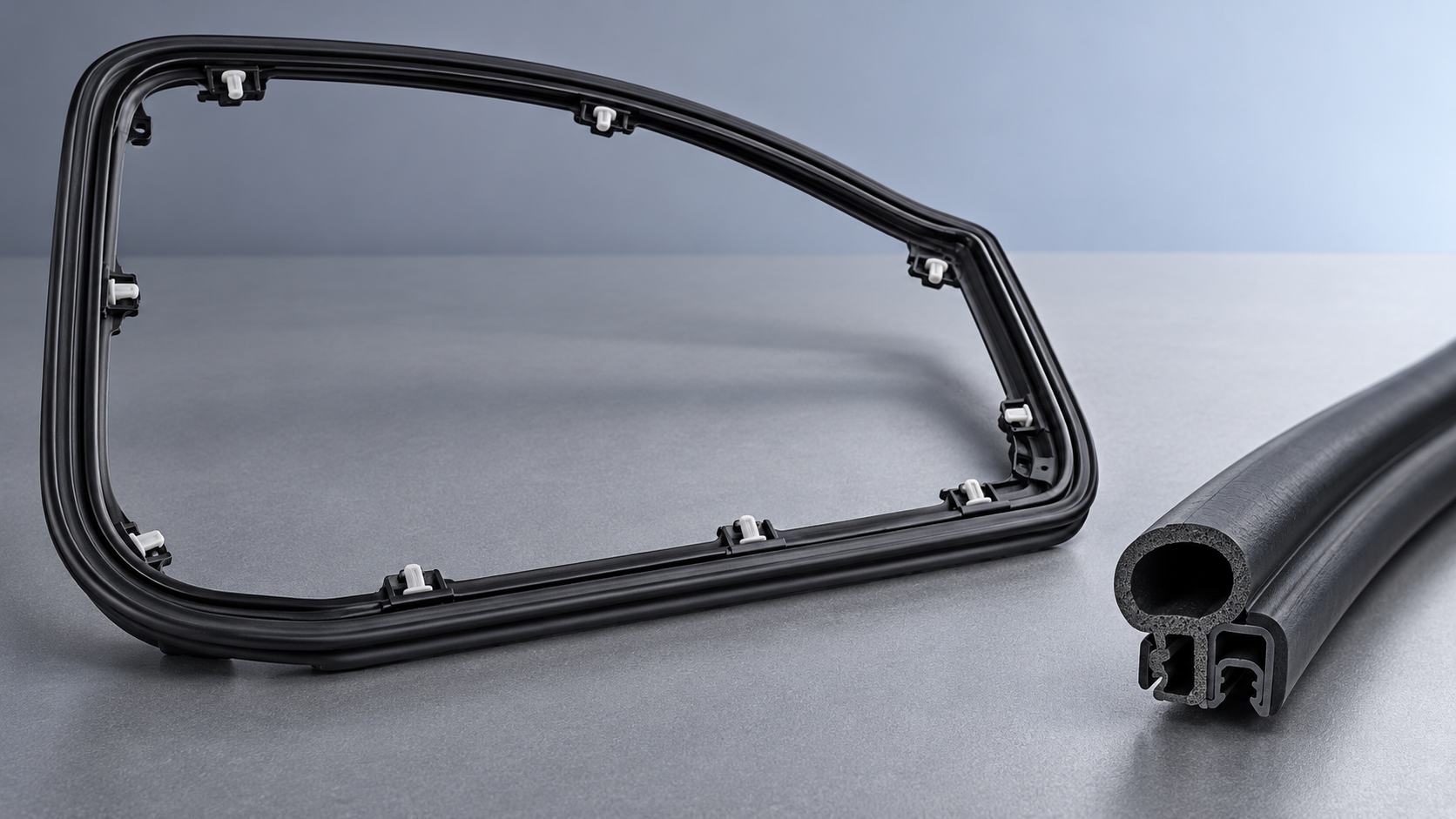
Complex geometry is a strong reason to purchase a preformed assembly. Tight corners, changing cross-sections, molded junctions, and precisely located clips are difficult to reproduce with a straight length of extrusion. A profile that looks similar in a catalog photograph can still sit incorrectly at the flange or leave a gap at a transition.
An assembly also becomes attractive when the existing carrier is cracked, corroded, or distorted, or when the rubber is permanently integrated into it. Attempting to attach fresh rubber to an unsuitable support adds labor without restoring the intended mounting geometry. Confirm whether the original design permits separate seal replacement before accepting a strip-only proposal.
Conversely, a straightforward, serviceable weatherstrip on an undamaged flange rarely gains value merely from being packaged with additional trim. If the exact replacement profile is available and the attachment system remains usable, replacing the rubber alone can deliver the required repair with fewer discarded components.
Availability affects the calculation, too. A complete assembly that arrives ready to install may reduce downtime compared with a separate seal requiring uncertain sourcing and fitting. That advantage disappears if the assembly has a longer lead time or an unclear fitment record.
EPDM quality: assess the finished profile
EPDM is widely used for exterior automotive weatherstripping because it offers resistance to ozone and weathering. The material name alone does not establish service life. Compound formulation, curing, sponge structure, surface treatment, and profile dimensions all influence how the seal compresses and recovers.
Hardness is particularly easy to misread. A harder seal is not automatically more durable or more effective. Excessive resistance to compression raises closing effort and can prevent full seating. An overly soft or poorly recovering profile can lose contact pressure. Bulb geometry, wall thickness, and compression behavior need to be considered together.
Appropriately specified reclaimed EPDM can be incorporated into suitable compounds, but acceptability depends on feedstock consistency, processing, formulation, and demonstrated finished-part performance. Reclaimed content alone does not prove poor quality, and it does not establish equivalence to the original seal. Request evidence relevant to compression set, heat aging, ozone resistance, and dimensional consistency under agreed test conditions.
Material selection must also follow exposure. A fuel-contact component such as an Oil Delivery Hose for Diesel Truck Engine Fuel Line System NBR Fuel Hose addresses a different duty from an exterior weatherstrip. Its NBR designation does not make it a substitute for an EPDM door seal; fuel resistance and weathering performance require separate evaluation.
Make the quotation specific enough to accept
Provide the vehicle identification details, body style, door position, and production information needed to resolve fitment variations. Specify whether the required part mounts to the door or body opening. Photographs of the attachment method and profile cross-section help distinguish visually similar seals, especially where earlier repairs may have introduced non-original parts.
The quotation should identify included clips, molded joints, adhesive requirements, and any reusable carrier. For a proposed equivalent, request dimensions and application evidence rather than accepting “universal fit” as proof. Confirm return conditions before trial installation, since cutting, adhesive application, or clip insertion can affect eligibility.
Agree on acceptance after installation: the seal should remain seated through normal door movement, corners should lie correctly, and closing effort should be assessed against the vehicle’s service requirements. Repeat the original water or noise assessment under comparable conditions. If the complaint remains, investigate its source before authorizing another seal purchase.
Leave A Message
If you are interested in our products and want to know more details, please leave a message here, we will reply you as soon as we can.