




Effective NVH Sealing Solutions reduce wind noise by maintaining continuous sealing contact across the door opening while keeping seal reaction forces within the available closing effort. Increasing compression to eliminate a leak often raises closing force and accelerates local deformation. A better starting point is to identify whether the noise comes from an air path, unstable seal contact, or aerodynamic excitation around the door frame. Each mechanism requires a different correction.
The governing relationship involves profile geometry, compression load deflection, door alignment, and pressure differences during driving. Compound hardness alone cannot describe this relationship. A soft profile with thick walls or trapped air can resist closure more strongly than a firmer profile designed to bend progressively.
Separate leakage noise from aerodynamic noise
A narrow interruption in sealing contact can create a concentrated air path and audible hiss. Corners, joints, changes in flange direction, and transitions near the mirror mounting area deserve particular attention. A seal that appears continuous with the vehicle stationary can lose contact when aerodynamic loading deflects the door frame at speed.
Wind noise also occurs without measurable leakage into the cabin. Flow separation around mirrors, pillars, and exterior gaps generates pressure fluctuations that excite the glazing and surrounding structure. Increasing primary seal compression will have limited benefit when this is the dominant transmission path.
Temporary masking of selected exterior gaps, local acoustic measurements, and controlled leakage testing help distinguish these mechanisms. Masking changes external airflow as well as potential leakage, so a quieter result identifies a sensitive region without proving the exact cause. Correlating that result with contact evidence and pressure measurements prevents an unnecessary increase in seal stiffness.
Read the compression curve across the working gap
Compression load deflection describes the force required to compress a profile through a specified displacement. For a hollow or sponge weatherstrip, the useful information is the curve across the actual installation range. A single force value at nominal compression conceals what happens at the tightest and widest door gaps.
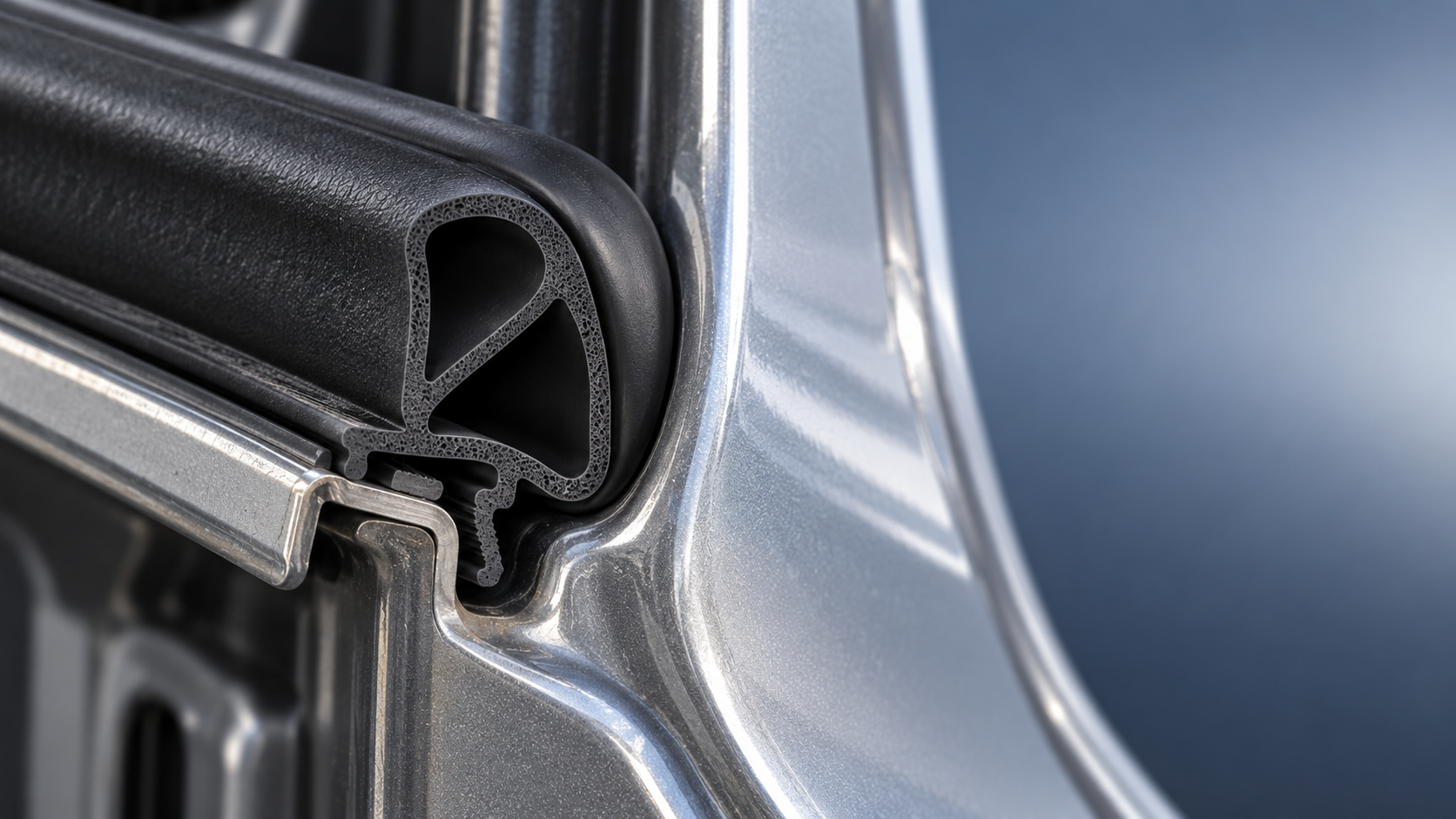
Early in compression, a hollow bulb generally deforms through wall bending. As its walls approach each other, the force can rise sharply. If production tolerances place part of the seal in this steep region, small changes in door position create large changes in closing effort. The design needs sufficient travel to maintain contact at the widest gap without excessive resistance at the tightest gap.
Record specimen length, compression direction, loading speed, temperature, and preconditioning when comparing curves. Profile force reported per unit length is only comparable when these conditions agree. Extruded sections also need representative support: restraining the base differently from the vehicle installation changes how the bulb rolls or collapses.
Seal force must then be related to door motion. Local reaction forces act at different distances from the hinge axis, so their contribution to closing torque varies around the opening. Minimum closing speed or closing energy also includes hinge friction, latch engagement, seal surface friction, and transient cabin pressure. A lower laboratory compression force does not automatically produce an easier closing door.
Use geometry to preserve contact without excessive load
Bulb wall thickness, cavity shape, contact lip angle, and base support determine how compression develops. A profile that folds predictably can accommodate dimensional variation with a moderate force increase. An unstable section can roll away from the intended contact surface, producing a leak despite substantial overall compression.
Contact width also needs context. A broad witness mark suggests engagement, but it does not establish sufficient local pressure everywhere. Conversely, a narrow contact band can seal effectively when its position remains stable. Evaluate continuity around the perimeter and through joints, then relate the contact pattern to leakage under representative pressure differences.
Vent holes in hollow weatherstrips affect air movement during compression. Their size and position influence transient resistance, but they also interact with water management and acoustic paths. They require validation in the installed assembly. Cabin pressure relief vents are a separate system; restrictions there should be resolved before changing the seal compound to address a pressure-related closing problem.
Evaluate EPDM compounds after conditioning
EPDM is widely used for exterior automotive weatherstrips because of its resistance to ozone and weathering. Finished performance still depends on formulation, cure, sponge structure, extrusion quality, and any surface treatment. Solid and cellular sections require different comparisons: a density change in sponge rubber can alter compression behavior even when a hardness reading appears similar.
Reclaimed EPDM introduces additional formulation variables. Its effect depends on the source material, reclaiming process, loading level, particle characteristics, and compatibility with the new compound. Approval should therefore rely on finished-profile performance and batch consistency rather than an assumed acceptable replacement percentage.
Compression set and retained sealing force answer different questions. Compression set measures residual deformation after a defined compression and recovery procedure. Stress relaxation measures the decline in force while deformation is maintained. A profile can recover visibly yet retain too little contact force during prolonged installation. Both properties matter when assessing long-term sealing.
Compare fresh profiles with samples conditioned under relevant heat, cold, humidity, and compression histories. Measure the compression curve again after conditioning, and assess joints alongside straight extrusions. Corner molding and joining processes can create stiffness changes or discontinuities that are absent from laboratory compound specimens.
Material comparisons must also respect application differences. A Solid Black Nitrile NBR Rubber Strip belongs to a different material and profile category from a cellular EPDM door bulb. NBR's oil resistance does not establish suitability for an exterior weatherstrip; weathering resistance, low-temperature response, and installed compression behavior require separate evaluation.
Define acceptance at material, profile, and vehicle levels
No single hardness, compression set, or acoustic test establishes the balance between wind noise and closing effort. Material tests characterize the compound; profile tests capture geometry and processing; vehicle tests include installation tolerances, aerodynamic loads, and door hardware. Acceptance criteria need to connect these levels.
Where standardized rubber test methods are specified, record the applicable edition, specimen preparation, conditioning, and test conditions. Results from different compression set procedures or specimen geometries should not be treated as interchangeable. Vehicle acoustic and closing requirements also need explicit operating conditions because a method name alone does not define an acceptance limit.
A practical validation sequence begins with compound screening, followed by profile compression and relaxation measurements across the expected gap range. Installed testing then correlates leakage, contact continuity, and closing behavior. Acoustic evaluation should control vehicle speed, wind direction, cabin ventilation settings, and background noise sufficiently to distinguish a seal change from test variation.
Closing measurements need comparable discipline. Door angle, window position, latch condition, temperature, and closure method affect results. Record the measurement definition: peak handle force, minimum closing speed, and closing energy describe different aspects of the event and should not substitute for one another.
Production release should preserve the relationship demonstrated during validation. Control profile dimensions, sponge density where applicable, cure condition, joint quality, and compression response across batches. A dimensional drift that moves the installed seal onto the steep part of its force curve can erase the closing-effort margin even when the compound still meets its material specification.
Leave A Message
If you are interested in our products and want to know more details, please leave a message here, we will reply you as soon as we can.