




Car EPDM Seals That Flatten or Crack: Diagnosing Premature Failure
Car EPDM seals that stay flattened or develop cracks can leave maintenance teams chasing wind noise, water leaks, and repeat customer complaints. Before replacing another door or trunk seal, identify whether the failure stems from compression set, installation stress, chemical exposure, or an unsuitable rubber compound. The damage pattern, its location, and the vehicle’s service history usually provide more useful evidence than the seal’s age alone.
EPDM generally resists weathering and ozone well, but that does not make every EPDM profile suitable for every sealing position. Compound formulation, sponge structure, curing, profile geometry, and fitting conditions all affect performance. A replacement that looks identical can still behave differently under sustained compression.
Read the damage before removing the seal
Photograph the seal in place, mark the affected section, and compare it with an undamaged area. Note whether the problem follows a corner, splice, latch position, or repaired body panel. Once the strip has been pulled off and stretched, valuable evidence about its original fit can disappear.
- A flattened bulb with little recovery: suspect compression set, prolonged overcompression, heat exposure, or collapsed sponge structure.
- A split concentrated at a tight corner: look for installation stretch, an unsuitable bend radius, or a profile forced to twist.
- Swelling, softening, or tackiness: investigate contact with incompatible cleaners, oils, fuels, or workshop chemicals.
- Localized polished or torn areas: check for rubbing against trim, misaligned panels, or a trapped section.
- Widespread surface cracking: consider aging and compound suitability, but do not diagnose the cause from appearance alone.
Check the leak path separately. Water entering near a door seal may originate at a glass channel, body seam, blocked drain, or disturbed moisture barrier. A damaged weatherstrip is evidence to investigate, not automatic proof of the leak source.
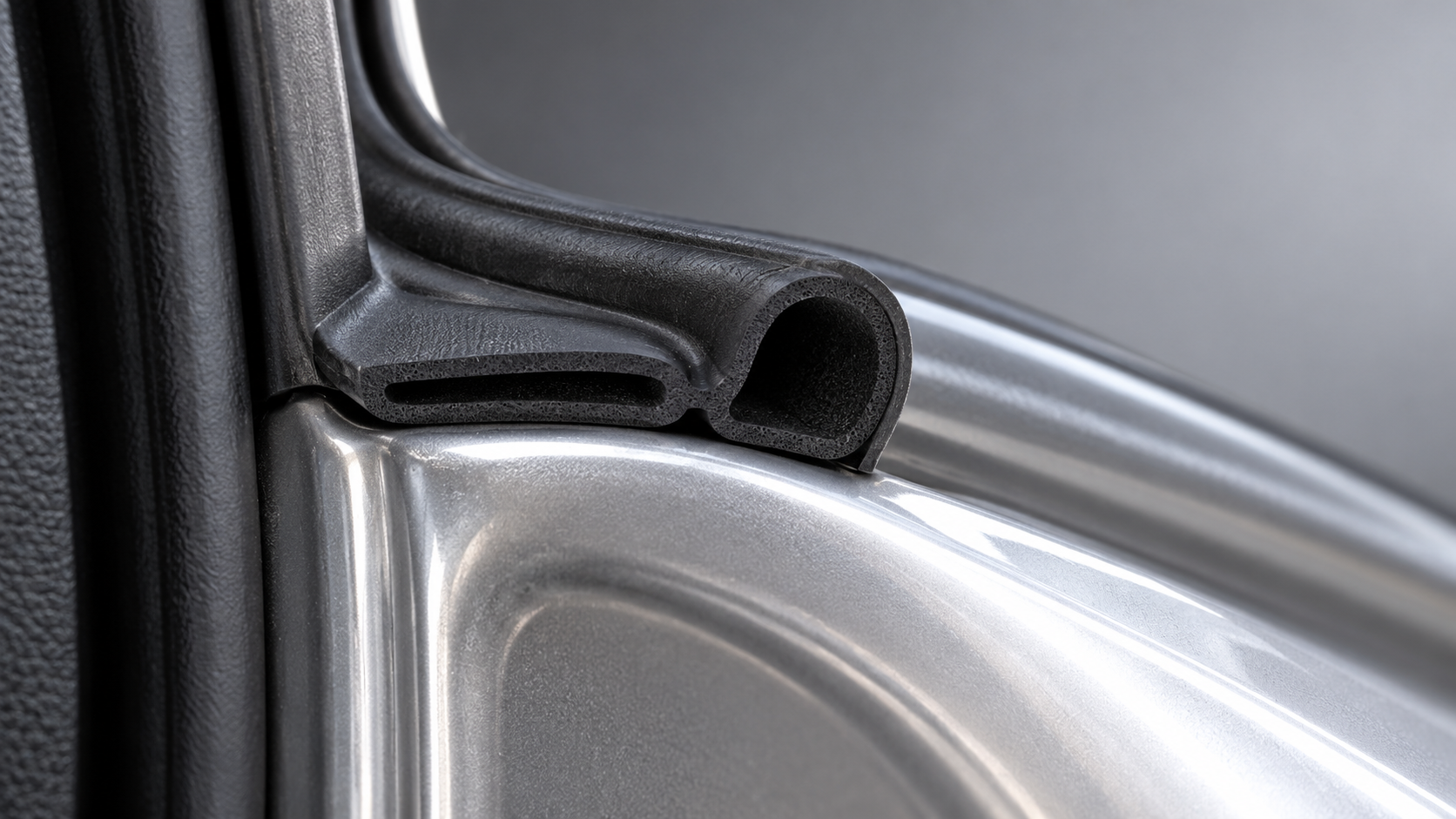
Flattening: separate material set from excessive squeeze
Compression set is the permanent deformation remaining after a rubber specimen has been compressed under defined conditions and then released. A workshop recovery check can flag a problem, but it cannot produce a laboratory compression-set value.
Open the door or trunk and allow the unloaded seal to recover under reasonably stable conditions. Compare its height and shape with an unaffected section of the same profile. Record the recovery period and temperature if the evidence will support a supplier discussion. A quick finger squeeze tests feel; it does not establish long-term sealing performance.
Next, inspect panel gaps, hinges, striker position, and the mounting flange against vehicle repair information. Excessive closing force is a warning, especially after collision work or seal replacement. A bulb compressed beyond its intended working range can lose useful travel even when the compound itself is acceptable.
An oversized replacement may seal initially but close poorly and deteriorate early. A smaller profile may close easily yet never establish continuous contact. Match the cross-section, carrier, mounting arrangement, and specified compression range—not simply the overall width.
Cracking: look for strain and chemical contact
Cracks at corners often point toward concentrated strain. Stretching a strip during fitting can leave it under tension after installation; subsequent movement may open splits or pull joints apart. Feed the profile into position without stretching it, following the vehicle or seal supplier’s fitting procedure.
EPDM is generally unsuitable for sustained contact with petroleum oils and fuels. If deterioration is concentrated near lubricated hinges, fuel-filler areas, or recently cleaned surfaces, ask what products were used. The exact formulation, concentration, exposure duration, and temperature matter. Not every cleaner attacks EPDM, and discoloration alone does not prove chemical damage.
Cracking may also affect a surface coating rather than the rubber underneath. Inspect carefully without aggressively bending the damaged section. A low-friction coating failure and a split through the bulb wall require different corrective action.
Weather resistance remains formulation-dependent. EPDM’s reputation for ozone resistance should not be used to dismiss widespread cracking—or to blame ozone without checking installation strain, contamination, and material identity.
Ask suppliers for evidence that matches the profile
“EPDM” identifies a polymer family, not a complete performance specification. Hardness alone is also insufficient: two profiles with similar hardness can differ in compression recovery, closing force, and aging behavior. Sponge and dense rubber need appropriate, clearly identified test methods.
For repeat failures, request the following information rather than a generic statement that the material is automotive grade:
- Profile controls: cross-sectional dimensions, tolerances, sponge density where applicable, and mounting details.
- Compression evidence: test method, specimen type, compression level, temperature, duration, and recovery conditions.
- Service-related testing: heat aging, weathering, chemical compatibility, and compression-deflection behavior appropriate to the application.
- Traceability: batch identification and relevant formulation or process changes between deliveries.
Results from different test conditions are not directly interchangeable. Nor does a result from a molded test slab necessarily describe a finished hollow extrusion. Ask whether the evidence represents the supplied profile or only its base compound.
Other door systems illustrate why application-specific evidence matters. Anti-pinch rubber strips for subway sliding doors operate under different geometry, movement, and system requirements. Their performance should not be treated as proof of suitability for a passenger-car weatherstrip, even where both applications use flexible rubber profiles.
Where reclaimed EPDM fits into the diagnosis
Reclaimed-rubber content alone neither proves nor rules out a material problem. Feedstock consistency, reclaim characteristics, blend proportion, and the complete formulation can influence processing and finished properties. Suitability must be demonstrated through the relevant compound and profile tests.
Hebei Weizhong Rubber Technology, based in Xingtai, has specialized in EPDM reclaimed rubber research, production, and sales since 1986. When discussing a custom reclaimed-rubber solution, provide the failed application, operating conditions, and target properties. This gives the material supplier a practical basis for evaluating an economical formulation rather than selecting material on price alone.
Close the repair with a controlled verification
Correct misalignment, contamination, or fitting stress before installing another seal. Clean the mounting surface with an approved product, preserve drain paths, and avoid unapproved lubricants or adhesives. Surface dressings may change appearance or friction; they do not restore permanent compression set or repair structural cracks.
After fitting, verify continuous contact and normal closing effort. Follow the manufacturer’s leak-test procedure; an uncontrolled high-pressure jet can create misleading results. Confirm wind noise under comparable driving conditions where safe, and document the replacement batch. If failure returns at the same corner, recheck geometry and installation. If it appears across correctly fitted vehicles using one batch, preserve samples and escalate the material investigation.
Leave A Message
If you are interested in our products and want to know more details, please leave a message here, we will reply you as soon as we can.