




A Triple-Compound Sealing Strip succeeds when its material zones work together: one holds the profile in place, another deforms to close the gap, and a third controls contact with the mating surface. A harder mounting section cannot compensate for a sealing bulb that loses contact pressure, and a smooth surface cannot correct poor bonding between compounds.
The term describes a construction approach, not a fixed material specification. Before comparing products, establish what each zone contains, where it sits in the cross-section, and which operating requirement it serves. Three colors or three hardness readings alone do not demonstrate a well-designed seal.
What each material zone contributes
A common arrangement combines a dense mounting section, a compliant sealing section, and a surface compound selected for friction or wear behavior. Other arrangements are possible. Some profiles use three dense compounds with different properties; others combine dense and sponge rubber. A flocked or coated surface does not automatically constitute a third co-extruded compound, so the construction drawing should identify the distinction.
These zones should be identified on a cross-sectional drawing, including the boundaries between compounds and the intended contact area under compression.
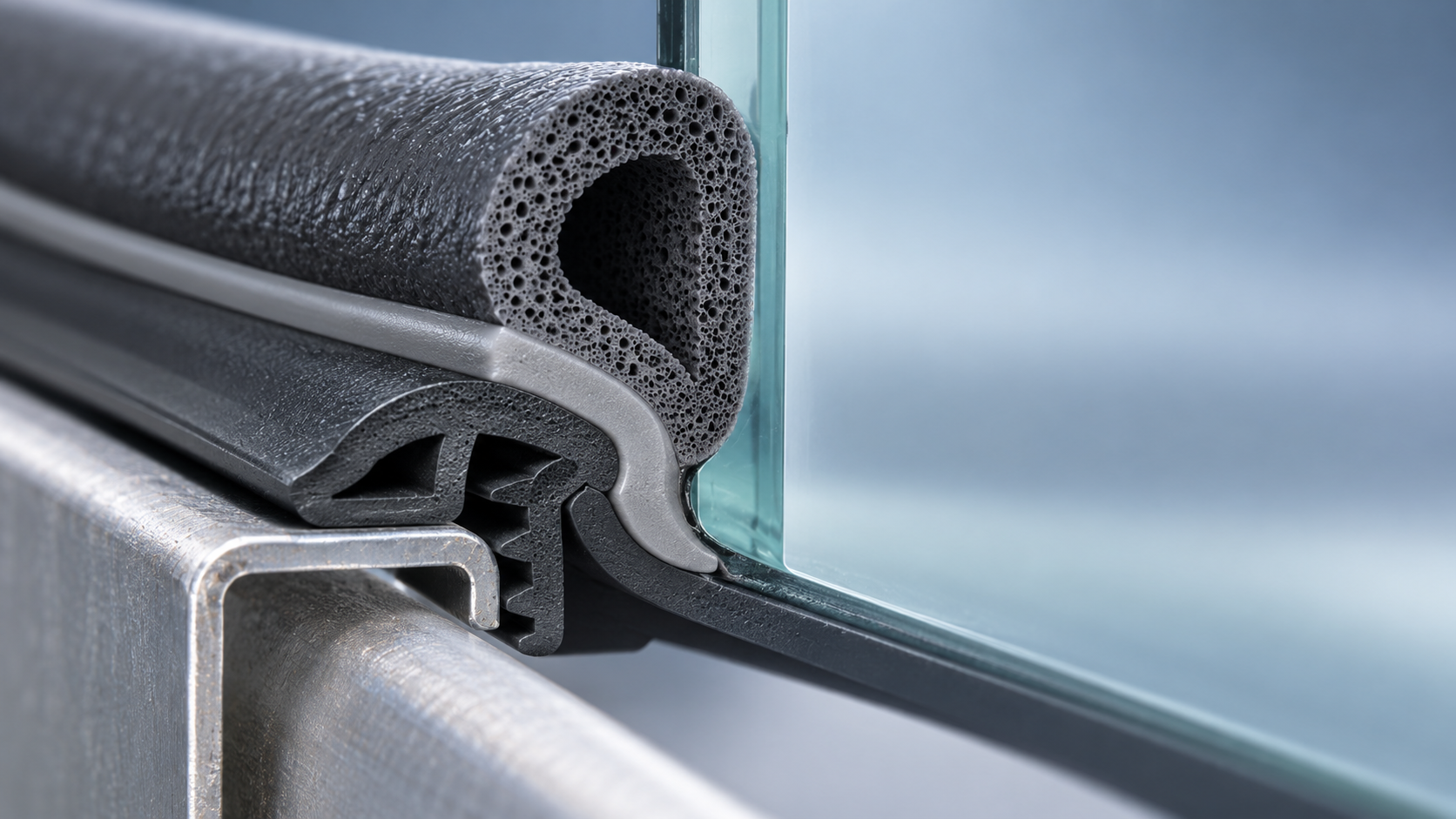
The mounting zone must hold without distorting the seal
The retention section transfers loads into a flange, groove, or carrier. Dense rubber often provides the stiffness needed here, but hardness is only part of the assessment. Wall thickness, gripping-lip geometry, dimensional tolerances, and any reinforcing carrier also influence attachment.
Excessive stiffness can make installation difficult or prevent the profile from seating fully. Insufficient stiffness can allow movement, twisting, or disengagement. Either condition changes the position of the sealing zone. Check retention on the actual mating geometry, including tolerance extremes and bends, because a straight sample on a nominal flange can conceal installation problems.
The compliant zone must maintain useful contact force
A sponge bulb or flexible lip accommodates gap variation and surface irregularities. Its job is to produce enough contact pressure to interrupt the leakage path while keeping closing or assembly force acceptable.
Softer material does not automatically produce a better seal. A bulb that collapses too easily may provide inadequate contact pressure. A profile compressed too far can develop high closing force, local buckling, or permanent deformation. For cellular rubber, density, cell structure, skin integrity, and wall geometry all affect behavior; a hardness value alone describes too little.
Compression set and stress relaxation address different concerns. Compression set describes residual deformation after a specified compression and recovery procedure. Stress relaxation describes the loss of sealing force while the material remains compressed. A seal can recover its shape reasonably well after release yet lose meaningful contact force during service. Applications involving long periods of closure therefore need attention to both.
The surface zone controls what happens at the contact line
Where a seal slides against glass, painted metal, or another moving component, the contact compound may reduce drag, sticking, noise, or wear. Its value depends on the actual mating surface, contact pressure, movement, and contamination.
Low initial friction is insufficient evidence of durability. Repeated movement may wear through a thin surface zone and expose material with different friction behavior. Dust can increase abrasion, while cleaners or lubricants can change surface interaction. Evaluation should include the relevant mating material and representative movement cycles, followed by inspection for wear, cracking, transfer marks, and changes in operating force.
Interfaces can determine whether the profile survives service
Each compound may perform well separately while the assembled profile fails at a boundary. Differences in formulation, cure behavior, stiffness, and thermal movement can concentrate stress where the zones meet. Corners, stretched installation sections, and repeatedly flexed lips deserve particular attention.
For co-extruded rubber, compatible processing and curing conditions help establish a durable interface. A visually continuous boundary does not prove adequate adhesion. Examine resistance to separation before and after relevant heat, moisture, and chemical exposure, and record where failure occurs. Separation along the interface indicates a different weakness from tearing within one compound.
Finished corners and splices also need evaluation. Joining can alter local geometry, stiffness, and material continuity, creating leakage paths even when straight lengths perform well. A representative assembly should therefore include production-style joints and the tightest intended bends.
Compare specifications under matching test conditions
There is no universal performance level implied by “triple-compound.” A useful specification connects each requirement to a named test method, specimen type, conditioning procedure, and acceptance criterion. Recognized rubber test standards provide methods, but application requirements determine which methods and limits are relevant.
When reviewing supplier data, prioritize these comparisons:
- Hardness and material form: identify the scale, specimen preparation, and whether the material is dense or cellular. Results from different methods are not directly interchangeable.
- Compression behavior: compare force at the intended deflection and examine recovery or force retention under relevant time and temperature conditions.
- Environmental resistance: select exposures based on actual sunlight, ozone, temperature, water, cleaning agents, oils, or other service fluids.
- Finished-profile performance: assess leakage, retention, operating force, and interface integrity using representative mounting conditions.
EPDM is commonly selected for weather-exposed seals because of its resistance to ozone, weathering, and many water-related environments. It is generally unsuitable for sustained contact with petroleum oils and fuels. A thin surface zone should not be assumed to protect an incompatible underlying compound throughout service, especially where cut ends, joints, or wear expose it.
Temperature claims also need context. Brief exposure and continuous compression at temperature impose different demands. Compare the condition of the complete profile after exposure, including bonding and contact-force retention, rather than relying only on a compound’s stated temperature range.
Where EPDM reclaimed rubber can fit
EPDM reclaimed rubber can be considered in selected formulations to control material cost and reuse rubber resources. Its suitability depends on the reclaimed feedstock, processing consistency, formulation, and the duty of the zone receiving it.
A less demanding support section may offer more formulation flexibility than a highly strained sealing lip or a thin contact layer. However, the mounting section still needs adequate tear resistance, dimensional stability, and retention. Reclaimed content should not be assigned to a zone solely because that zone is hidden from view.
Changes in reclaimed rubber content can affect viscosity, extrusion behavior, cure response, surface quality, and mechanical properties. In a multi-compound profile, these changes may also influence interface bonding. Approval therefore requires evaluation of the finished construction, alongside compound-level tests.
Hebei Weizhong Rubber Technology specializes in EPDM reclaimed rubber research, production, and sales. For a formulation discussion, the useful starting information is the intended zone, service environment, processing requirements, and performance limits. A reclaimed-content percentage by itself does not establish suitability.
Start qualification with the joint and its movement
Before selecting a formulation, define the minimum and maximum gap, attachment geometry, movement direction, expected compression, and exposure conditions. These inputs determine whether the profile needs greater flexibility, stronger retention, lower sliding resistance, or a different sealing mechanism.
A moving closure and a confined concrete construction joint present different demands. A Water-Swelling Waterstop Strip belongs to a different solution category, where water-induced expansion is used within a suitably detailed joint. It should not be treated as interchangeable with a compression seal for repeated opening or sliding.
For a triple-compound profile, request a marked cross-section, a zone-specific material specification, and finished-profile results under representative conditions. Then examine the seal at the widest gap, greatest compression, tightest bend, and relevant aged condition. Those checks reveal whether the three zones continue to support attachment, contact pressure, and surface performance throughout the intended operating range.
Leave A Message
If you are interested in our products and want to know more details, please leave a message here, we will reply you as soon as we can.