




Custom Garage Door Seal Manufacturing: Tooling, Tolerances, and Minimum Orders
Sourcing a custom garage door seal involves more than matching a profile drawing. Tooling charges, dimensional tolerances, and minimum order quantities all affect whether a quotation represents good value. A low price per meter can become expensive if the seal pulls out of its retainer, arrives in impractical coil lengths, or requires repeated tooling corrections.
When choosing a garage door seals manufacturer, the useful question is not simply “Can you make this shape?” It is “What must we agree on so this shape fits, performs, and can be reordered consistently?” That conversation should happen before the purchase order, not after the first shipment.
Start with the retainer and operating conditions
An existing seal is a useful reference, but a worn sample is a poor dimensional master. Rubber may stretch during removal, take a permanent compression set, or change shape in service. Ask the supplier to compare the sample with a dimensioned cross-section and, where possible, a section of the actual retainer.
For a bottom seal, separate the attachment geometry from the sealing body. T-shaped ends, beads, and sliding channels need to engage the retainer securely. The flexible section must accommodate the intended floor gap without demanding excessive closing force. Those are different functions and should not automatically receive identical tolerance requirements.
Describe the installation conditions as well: exposure to sunlight, expected temperature range, contact with cleaning products, and whether installers slide the seal into a long track or fit it in shorter sections. A profile that looks correct on a drawing may still be difficult to install when friction builds along the retainer.
Tooling: establish what the charge actually buys
For an extruded rubber profile, the die opening is not simply a full-size copy of the finished cross-section. The tool design must account for compound flow, die swell, curing behavior, and dimensional change after processing. That is why a visually simple profile can still require trial runs and adjustments.
Before authorizing tooling, ask whether an existing die can meet the functional requirements. A standard profile may avoid development expense, but only if its attachment geometry and compression behavior suit the door system. Accepting a near-match solely to save the tooling charge can move the cost into installation labor and replacements.
For a new tool, put these terms in writing:
- Whether the charge includes trial material, sample delivery, and correction rounds.
- Who owns the tool and whether ownership includes any right to transfer it.
- Who pays for maintenance, replacement, or changes after drawing approval.
- How long inactive tooling will be retained and under what conditions.
Paying a tooling invoice does not, by itself, settle ownership or transfer rights. Also separate tooling lead time from sample approval and production lead time. An available die does not mean an approved seal is ready to ship.
Tighten tolerances where failure is costly
Applying tight tolerances to every dimension can increase inspection effort, rejection risk, and price without improving fit. Instead, identify critical dimensions: the attachment head, neck thickness, channel engagement, and any thin wall vulnerable to tearing. Wider limits may be acceptable elsewhere, provided the assembled seal still performs.
A hollow rubber section also deforms when measured. Buyer and supplier should agree on measurement methods, sample conditioning, and how unsupported sections are positioned. Otherwise, two inspectors can report different results on the same piece. If a recognized rubber extrusion tolerance standard is proposed, confirm its applicable class and exceptions rather than accepting a general reference.
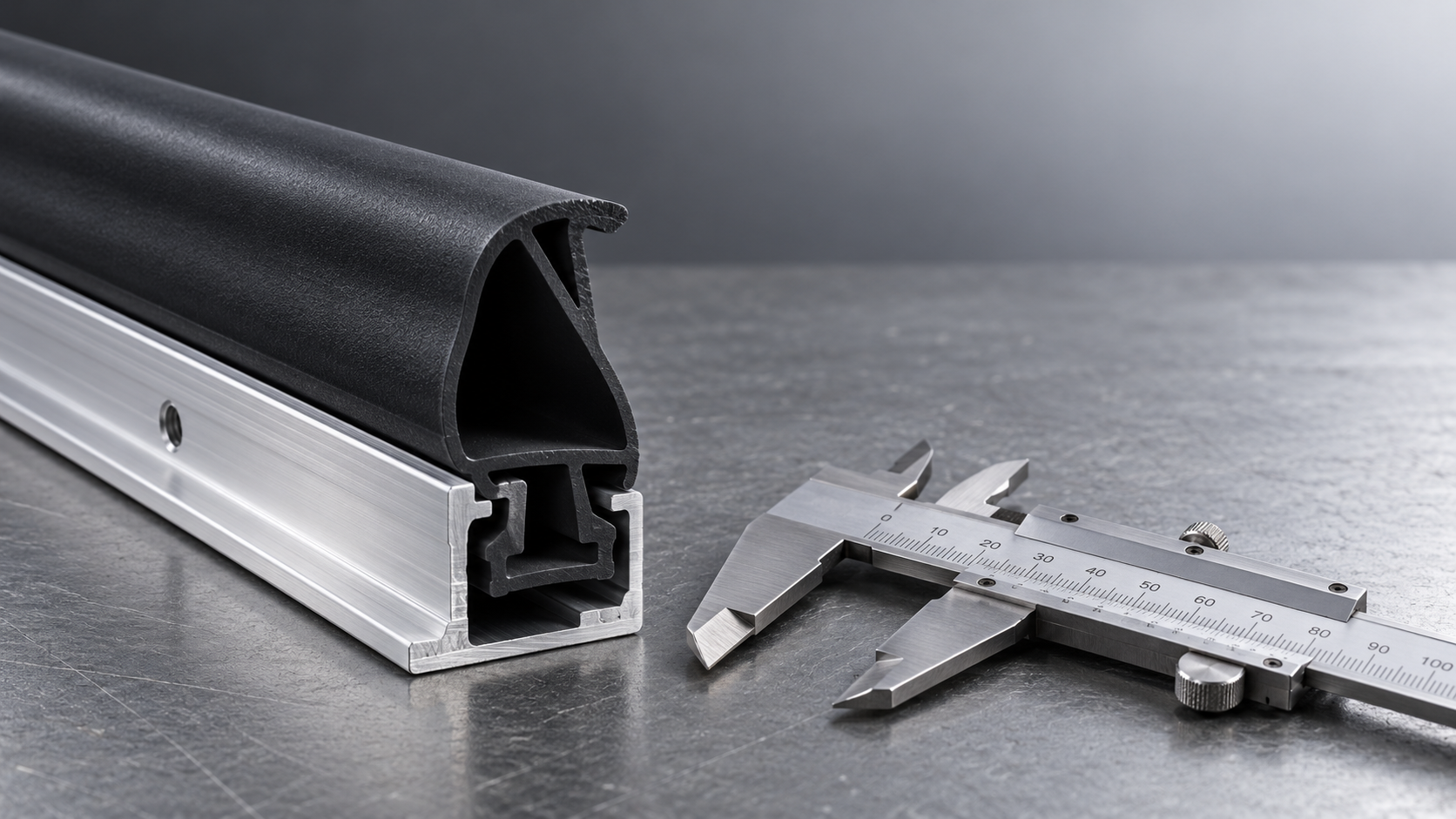
Dimensional approval should be paired with a fit check in the intended retainer. Review insertion effort, retention, and sealing contact across the expected gap. For long installations, test a representative length; a short sample may not expose cumulative sliding resistance. Agree on cut-length tolerances separately, including how the material is relaxed before measurement.
Specify the compound, not just “EPDM”
EPDM is commonly considered for outdoor seals because of its weathering and ozone resistance, but the polymer name alone does not define the finished product. Hardness, compression recovery, tear resistance, and low-temperature flexibility depend on formulation and processing. Solid rubber and sponge constructions also require different specification approaches.
When reviewing an EPDM Garage Door Bottom Seal, request the material specification behind the profile. Hardness alone cannot establish whether a hollow seal will compress appropriately; wall thickness and geometry matter too. Likewise, a softer compound is not automatically better if it compromises retention or tear resistance.
Reclaimed EPDM can be part of a cost-focused formulation, but its suitability depends on the reclaim quality, loading, overall compound, and required performance. Hebei Weizhong Rubber Technology, based in Xingtai, has specialized in EPDM reclaimed rubber research, development, production, and sales since 1986. That material-side expertise is relevant when discussing formulation economics, but it should not replace finished-seal testing or confirmation of who handles extrusion and quality approval.
Minimum orders are often a production constraint
A custom run requires line setup, compound preparation, process stabilization, and inspection before saleable output is established. Suppliers may therefore base minimum orders on profile length, compound batch weight, order value, or a combination. Ask which constraint drives the quoted MOQ.
This distinction matters when negotiating. If compound preparation is the limiting factor, increasing meters may not be the only option; compatible profiles might share a material batch if the supplier permits it. If extrusion setup is the main cost, a paid pilot run may be more practical than forcing an uneconomic production quantity. Neither arrangement should be assumed.
Clarify whether the MOQ applies per profile, color, hardness, or cut length. Also distinguish a blanket-order commitment from individual release quantities. Scheduled releases only reduce inventory exposure if storage responsibility, payment timing, and cancellation terms are clear.
Compare the cost of usable seals
Normalize quotations around the same drawing revision, compound requirements, lengths, packaging, and delivery terms. Separate one-time tooling and development charges from recurring production costs. Then include freight, receiving inspection, installation waste, and inventory carrying cost. A cheaper coil can lose its advantage if it leaves excessive offcuts.
Before production approval, request samples made with the intended tooling and production compound. Retain an approved reference sample alongside the controlled drawing, and require notification before material or process changes that could affect fit or performance.
The strongest purchasing decision is not necessarily the lowest initial quotation. It is the offer with clear acceptance criteria, workable order quantities, and a defined route from trial samples to repeat supply. If attachment fit remains unresolved, settle that before negotiating the final volume discount.
Leave A Message
If you are interested in our products and want to know more details, please leave a message here, we will reply you as soon as we can.