




A low price per meter makes EPDM rubber strips cost-effective only when the supplied profile fits correctly, maintains the required seal, and produces enough usable installed length. A cheaper strip can become more expensive through excessive stretching during installation, rejected sections, adhesive failure, or early replacement. The useful comparison is cost per accepted installed meter over a defined service period, with dimensions and performance held consistent.
Before comparing quotations, establish whether they describe the same product. Two black EPDM strips with similar outer dimensions can differ substantially in cross-sectional area, density, internal structure, and compression behavior. Those differences affect both the quoted rate and the cost of keeping the joint sealed.
A meter measures length, not the amount of rubber
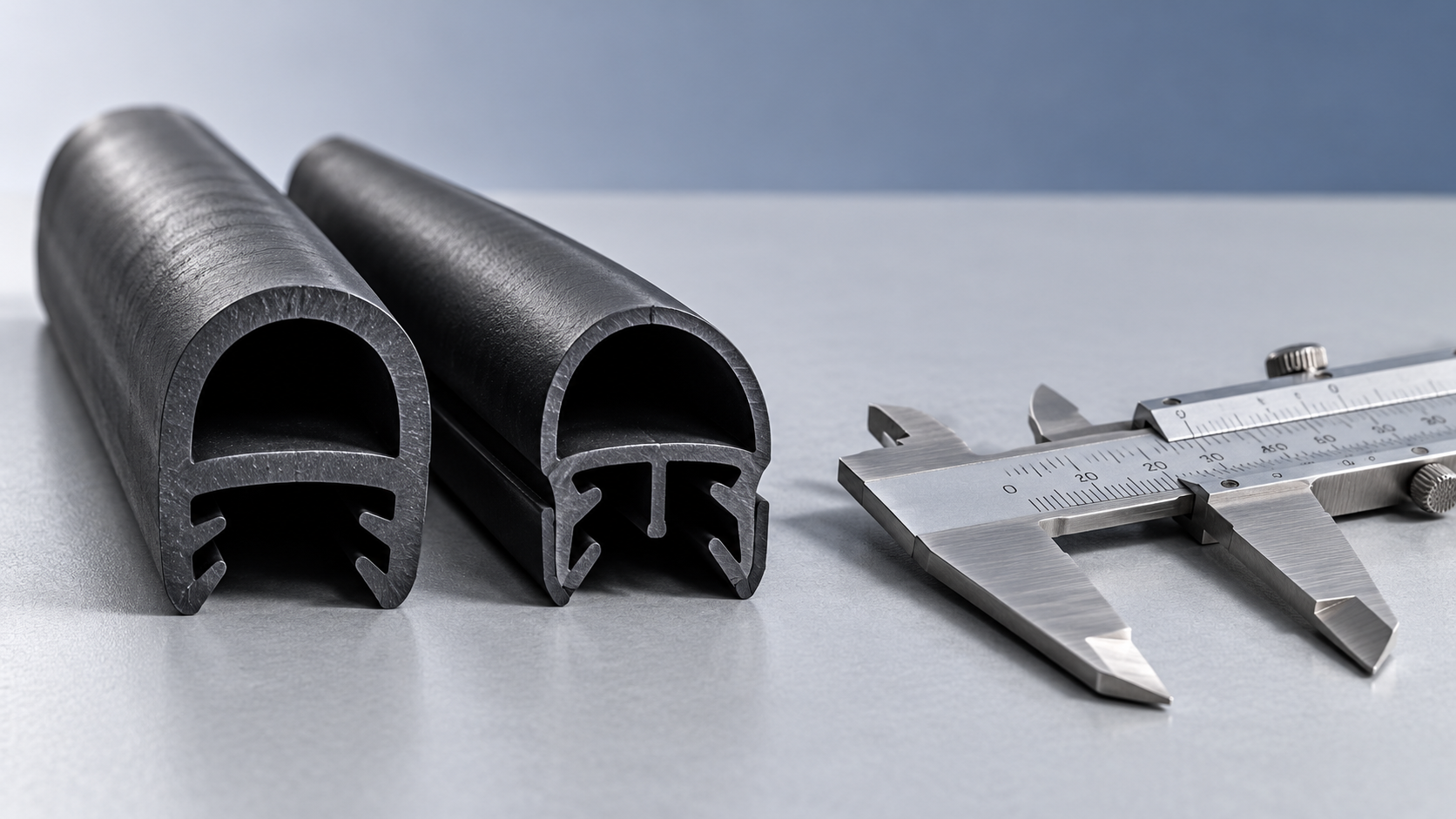
For a solid extruded profile, material consumption follows cross-sectional area and compound density. A wider base or thicker wall uses more compound per meter. Hollow profiles add another complication: matching external dimensions does not establish equal wall thickness or equal resistance to compression.
A useful relationship is:
Mass per meter = rubber cross-sectional area × compound density, using consistent units.
This calculation helps explain a price difference, but it does not establish quality. Higher density can result from the formulation rather than additional useful rubber. For sponge EPDM, apparent density also reflects the cellular structure; it cannot be compared directly with solid EPDM as a performance ranking.
Request a dimensioned cross-section showing the sealing surface, attachment base, hollow chambers, and critical wall thicknesses. Define tolerances around the features that control fit. A small dimensional deviation at a retaining foot can cause installation difficulty even when the overall width remains acceptable.
Mass per meter provides a useful consistency reference once a profile and formulation have been approved. An unexplained change warrants investigation, although an unchanged mass does not prove unchanged composition or sealing performance.
Formulation savings need a performance boundary
EPDM compounds contain more than polymer. Fillers, processing aids, curing ingredients, and other components influence extrusion behavior, hardness, strength, and recovery after compression. The material description “EPDM” alone leaves too much unspecified for a meaningful price comparison.
Reclaimed EPDM can contribute to an economical formulation when its source, processing, and inclusion level are controlled. Its suitability depends on the finished compound and application. A static cushioning strip and a repeatedly compressed weather seal place different demands on recovery, tear resistance, and fatigue behavior.
Neither reclaimed content nor virgin content establishes value by itself. Ask for properties measured on the proposed production compound and, where geometry matters, evaluate the finished profile. A generic material sheet does not show whether a thin retaining lip will survive insertion or whether a hollow bulb will recover after prolonged closure.
Hardness is particularly easy to overinterpret. Matching hardness values do not establish matching compression force, compression set, or durability. Compression set describes residual deformation after specified compression and recovery conditions; it does not independently predict service life. Results are comparable only when test conditions, specimen preparation, and reporting methods align.
The cheapest profile can make assembly expensive
A seal must develop sufficient contact pressure within the available closing force. Excessively stiff material can prevent a lid from seating or increase latch loads. An overly soft profile can flatten without maintaining adequate pressure across an uneven gap. Either mismatch creates costs that the meter price conceals.
Evaluate the profile across the actual gap range, including joint tolerances and corners. A strip that works at the nominal gap may leak at the widest opening or become difficult to close at the narrowest point. For hollow and sponge sections, the force needed to compress the complete profile is often more informative than a hardness reading alone.
Installation introduces further differences. Stretching a strip to make it fit reduces its cross-section and creates a tendency to retract, opening gaps at joints. Tight corners can buckle a base or collapse a hollow chamber. These problems require changes to profile selection, cutting allowance, or joining method; ordering extra length alone does not resolve them.
For adhesive-backed strips, evaluate the complete attachment system. Substrate cleanliness, surface texture, installation temperature, and time before loading affect adhesion. A backing that holds during initial assembly can still lift after repeated compression or environmental exposure. Include representative surfaces and dwell conditions in the trial.
Set the material boundary before calculating savings
EPDM is widely used for weather-exposed seals because of its resistance to ozone and weathering. Suitability still depends on compound formulation, temperature, contact media, and mechanical demands. Petroleum oils and fuels are a particular compatibility concern; a low quotation has little relevance if the material is unsuitable for the exposure.
Heat ratings also need context. Continuous exposure, brief temperature peaks, compression, and contact with cleaning chemicals do not impose equivalent conditions. A temperature statement without duration and test context is insufficient evidence for a demanding sealing application.
For oven-door duties, a product described as High-temperature resistant E-type silicone oven door seal belongs to a different material comparison. Its suitability still requires verification of temperature exposure, profile fit, and compression behavior. Comparing its meter price directly with a general-purpose EPDM strip would obscure the application requirements that determine usable value.
Turn each quotation into the same cost calculation
Separate the delivered purchase cost from the costs of converting supplied length into an accepted seal. This prevents a quotation with cheaper material but unfavorable supply conditions from appearing artificially attractive.
Initial cost per accepted installed meter = total delivered material, installation, and rework cost ÷ accepted installed length. For a service-period comparison, add replacement-related costs within the same defined period. Keep uncertain replacement assumptions visible instead of presenting them as established savings.
Coil length deserves attention when assemblies require uninterrupted sections. Shorter coils can increase remnants even if the total ordered length is identical. Conversely, unusually large coils can complicate handling or deform sensitive sponge profiles during storage. Specify acceptable packaging and splice rules alongside the length requirement.
Use a trial to resolve the expensive uncertainties
A useful trial reproduces the conditions most likely to change the purchasing decision. Fit production-representative material into the intended groove or onto the actual substrate. Assess closure force and sealing across the gap range, then expose the assembly to relevant compression, temperature, moisture, or cleaning conditions before reassessing it.
Agree on acceptance criteria before reviewing results. These might include retention in the groove, a defined leakage limit, acceptable closing force, or recovery sufficient to maintain contact after exposure. Avoid assigning a precise service-life claim to a short trial unless an established correlation supports it.
Record the approved drawing revision, compound reference, sample identification, and relevant test conditions with the purchase specification. If a later quotation changes the formulation, geometry, adhesive, or packaging, evaluate the affected requirement again. A price reduction becomes a credible saving when the revised supply continues to meet the conditions that made the original strip acceptable.
Leave A Message
If you are interested in our products and want to know more details, please leave a message here, we will reply you as soon as we can.