




EPDM rubber strips for construction must maintain effective seals despite sunlight, ozone, temperature changes, and sustained compression. For quality control and safety teams, material selection therefore requires more than a supplier’s durability claim: it calls for relevant weathering tests, compression set data, and traceable acceptance criteria.
The difficult part is not obtaining a report. It is deciding whether that report represents the strip installed in a window, façade joint, door frame, or roofing detail. A laboratory result can be accurate yet unsuitable for the purchasing decision if the specimen, exposure conditions, or recovery procedure differs from the project specification.
Establish the acceptance basis before reviewing test results
There is no single universal “construction EPDM certification” covering every strip and application. Requirements depend on the sealing system, exposure, jurisdiction, and contract documents. Standards generally define test procedures; they do not automatically establish a suitable pass limit for every building detail.
For building gaskets and weatherstripping, the EN 12365 series may be relevant where specified. ASTM D2000 can support rubber compound classification when a defined designation is used, but a material classification does not, by itself, verify an installed seal’s performance.
Before requesting samples, document:
- Service conditions: exterior or sheltered exposure, temperature range, water contact, and possible chemical contamination.
- Joint behavior: intended compression, installation tolerances, movement, and whether the seal is static or repeatedly opened.
- Material construction: solid or cellular EPDM, hardness or density range, profile geometry, and any adhesive backing.
- Acceptance rules: specified test methods, conditions, permitted property changes, sampling frequency, and rejection criteria.
Keep material identity separate from product naming. For example, a listing for Nitrile NBR Broom Strips should not be treated as evidence of EPDM weathering performance. NBR and EPDM have different exposure strengths; a strip’s appearance or commercial description cannot establish interchangeability.
Weathering evidence: distinguish sunlight, ozone, and heat
“Weather-resistant” combines several separate claims. EPDM is widely selected for outdoor sealing because of its resistance to ozone and weather exposure, but the finished compound still depends on formulation, curing, processing, and profile design.
These methods are not interchangeable. Heat aging does not establish UV resistance, and an ozone test does not reproduce rain, sunlight, or joint movement. Likewise, xenon-arc and fluorescent UV results should not be compared as though equal exposure hours represent equal severity.
Ask what changed—not simply whether the sample “passed”
A useful weathering report identifies the compound, specimen source, applicable standard edition, exposure settings, and assessment method. Depending on the specification, evaluation may include cracking, surface deterioration, hardness change, tensile strength retention, and elongation retention.
Visual examination matters, but appearance alone is insufficient. A strip can remain visually acceptable while becoming harder and less able to accommodate joint movement. Conversely, a color change may be cosmetic rather than a sealing failure. Define those distinctions before testing.
Do not convert accelerated exposure hours directly into years outdoors unless a validated correlation exists for the material, exposure environment, and failure criterion. Laboratory weathering is valuable for qualification and comparison, not an automatic service-life guarantee.
Compression set: a percentage needs its test conditions
Compression set measures residual deformation after a specimen has been compressed under defined conditions and then allowed to recover. Lower values generally indicate better dimensional recovery under that particular test. They do not directly quantify retained sealing force.
For solid rubber, ISO 815-1 and ASTM D395 are commonly referenced. ASTM D395 includes different methods; Method B uses constant deflection. Cellular EPDM requires methods and specimen arrangements appropriate to its structure, potentially under specifications such as ASTM D1056 where applicable. Do not assume a solid-rubber procedure produces meaningful comparisons for sponge profiles.
For a constant-deflection test, the basic relationship is:
Compression set (%) = (initial thickness − recovered thickness) ÷ (initial thickness − compressed thickness) × 100.
The method’s definitions, measurement procedure, and recovery requirements govern the actual calculation. A bare percentage without those details is not a reliable acceptance record.
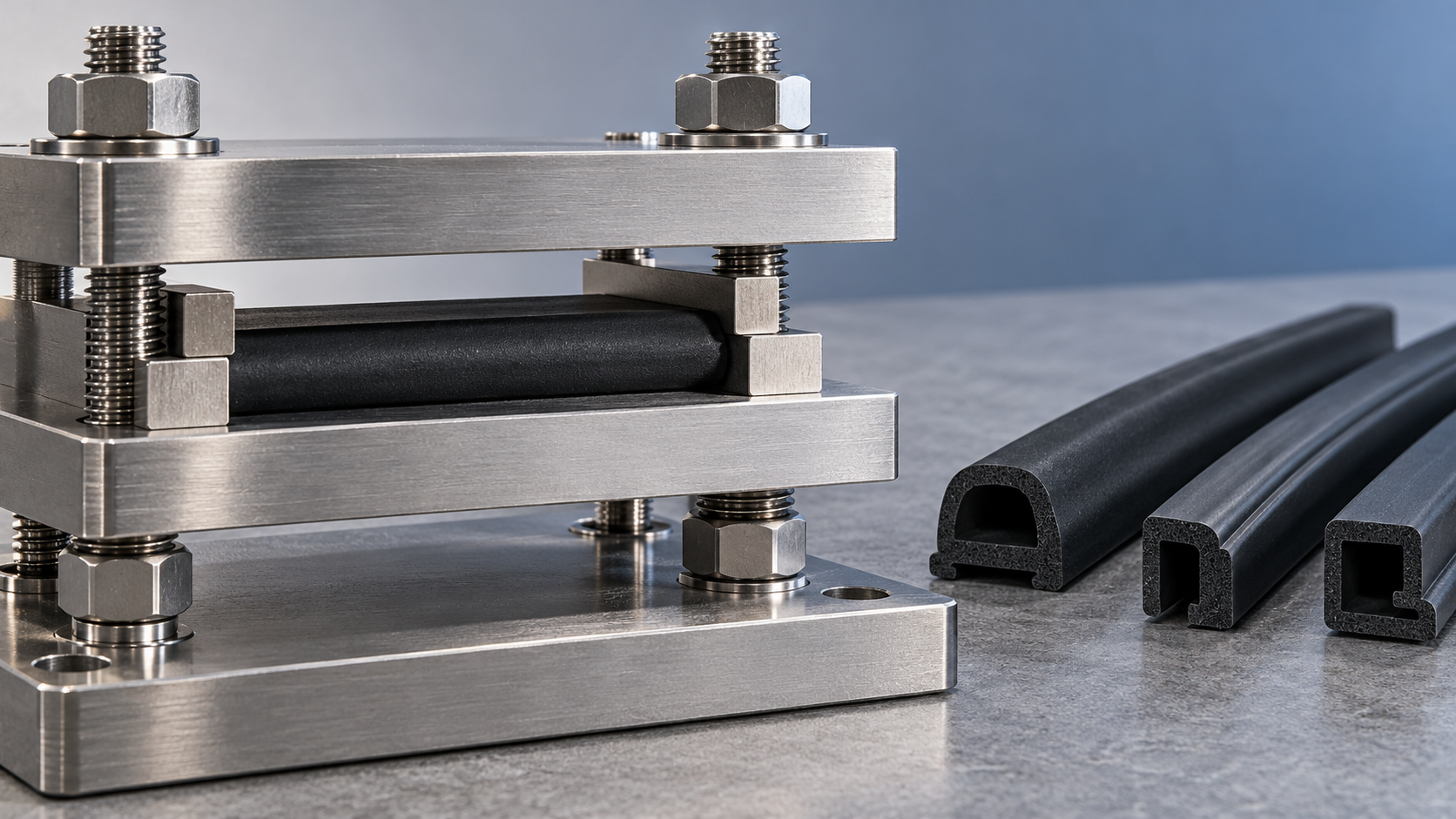
When comparing suppliers, put the following conditions side by side:
- Test standard, edition, and method.
- Specimen dimensions and whether specimens came from production strips or separately molded sheets.
- Compression level, exposure temperature, and duration.
- Release procedure, recovery temperature, and recovery interval.
- Individual results, replicate count, and reported summary value.
Consider two reports showing different compression set values. If one uses a shorter, cooler exposure and a longer recovery period, its lower result may not indicate a better compound. Align the conditions before ranking materials.
Why a good compression set result can still leave a leaking joint
A seal needs adequate contact pressure throughout service. Compression set describes recovery after release, whereas compression stress relaxation examines the loss of force while deformation is maintained. Where long-term sealing force is critical, consider stress-relaxation testing, such as ISO 3384-1, alongside compression set.
Geometry also matters. A molded test specimen cannot reveal every risk in an extruded hollow profile, a corner joint, or an adhesive-backed strip. Verify installation compression, profile dimensions, splice quality, and fit. Where required, test air or water leakage in the relevant assembly rather than inferring system performance from compound data.
Qualifying EPDM rubber strips for construction with reclaimed content
Reclaimed EPDM should neither receive automatic approval nor automatic rejection. Its suitability depends on feedstock consistency, reclaim processing, formulation, cure system, and the finished compound’s demonstrated performance.
Hebei Weizhong Rubber Technology has specialized in EPDM reclaimed rubber research and development, production, and sales since 1986. For manufacturers considering reclaimed EPDM in construction sealing compounds, the useful discussion is application-specific: what material characteristics are needed, which tests will govern qualification, and how formulation changes will be controlled.
A reclaimed-rubber supplier’s data can support raw-material selection, but it does not certify a customer’s finished strip. Request traceability between incoming material, production compound, and tested profile. Establish agreed controls for relevant material characteristics and require notification of changes that could affect weathering, curing, or compression behavior.
Run qualification on the intended production formulation. If reclaimed content, supplier, cure package, or processing conditions change materially, assess whether partial or full requalification is necessary. A report for an earlier compound should not silently carry forward.
Release the batch only when the evidence connects
A defensible release file should connect the purchase specification to the tested material and the delivered lot. Check report authenticity, sample identification, dates, laboratory competence, and deviations from the agreed method. If accredited testing is required, confirm that the laboratory’s ISO/IEC 17025 accreditation scope covers the relevant testing—not merely that the laboratory holds accreditation.
Use incoming inspections for dimensions, appearance, hardness or density, and identification as appropriate. Periodic qualification testing and routine lot checks serve different purposes; neither should be presented as a substitute for the other.
If a result is missing or outside the agreed limit, hold disposition pending documented review rather than accepting a generic durability statement. For safety and quality teams, the strongest purchasing decision is a traceable chain: relevant exposure conditions, comparable test results, controlled production, and evidence that the finished seal works in its intended joint.
Leave A Message
If you are interested in our products and want to know more details, please leave a message here, we will reply you as soon as we can.