




Electrical Cabinet Seals: Gasket Requirements for IP-Rated Enclosures
Electrical cabinet seals protect sensitive components from dust and water, but selecting a gasket does not establish an enclosure’s IP rating. Performance depends on the complete assembly: door stiffness, gasket geometry, joints, fastening points, cable entries, and the condition of mating surfaces.
For technical evaluation, the useful question is not simply whether a material is “waterproof.” It is whether the installed seal maintains sufficient contact pressure across manufacturing tolerances, operating temperatures, and repeated access. EPDM-based compounds can be suitable, including formulations containing reclaimed EPDM, but their acceptance must follow application-specific testing rather than material labels.
An IP rating belongs to the enclosure, not the rubber
IEC 60529 classifies protection provided by enclosures. The first characteristic numeral addresses access to hazardous parts and ingress of solid foreign objects; the second addresses water ingress. IP6X denotes dust-tight protection, while IPX5 and IPX6 concern water jets under different test conditions. IPX7 addresses temporary immersion under prescribed conditions.
These distinctions affect gasket design. An immersion classification does not automatically demonstrate compliance with water-jet requirements. Where both exposures matter, the relevant tests and marking need confirmation. Likewise, NEMA enclosure Types should not be treated as direct substitutes for IP codes: their requirements and scope differ.
Ask for the enclosure test report and its configuration, not just a gasket datasheet carrying an IP claim. Door dimensions, latch arrangement, mounting orientation, penetrations, and installation instructions can all define the limits of the tested design. Changing a seal profile or compound may require revalidation.
Start with the compression window
A seal must accommodate the largest local gap without losing contact and the smallest gap without excessive crushing or closing force. Nominal dimensions alone cannot establish that window. Door bow, flange flatness, coating thickness, hinge alignment, and latch adjustment all contribute to the installed gap.
For a simple profile, nominal compression can be calculated as the free gasket height minus the closed gap, divided by the free height. However, hollow bulbs and sponge profiles do not behave like solid rectangular sections. Their compression-force response must be measured for the actual profile; there is no universal compression percentage suitable for every cabinet seal.
Excess compression is not extra protection. It can raise latch loads, distort the door, accelerate permanent deformation, or damage the profile. Insufficient compression leaves weak points, often between fastening locations or at corners.
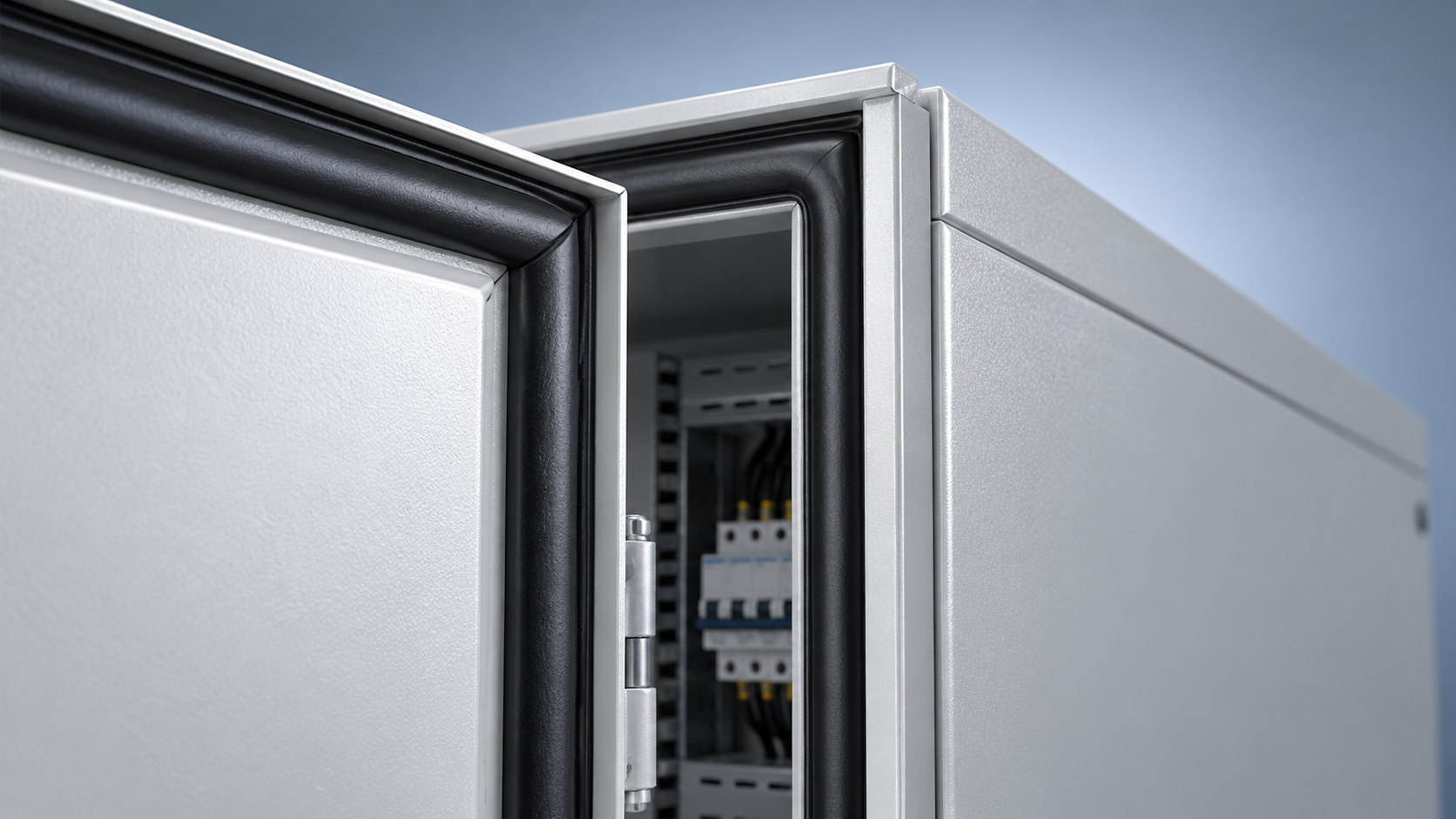
A section drawing showing free height, minimum and maximum closed gaps, and the sealing contact path is often more useful than another material brochure. Pair it with compression-force data so the enclosure designer can check both sealing contact and closure loads.
Recovery matters after the door has stayed shut
Compression set measures residual deformation after a specimen has been compressed and allowed to recover under specified conditions. Methods such as ISO 815-1 or ASTM D395 can support comparison, but results are meaningful only when temperature, duration, compression, and recovery conditions are comparable.
Compression set is not the same as retained sealing force. Stress relaxation describes declining force while a seal remains compressed. A gasket may still appear intact yet provide insufficient contact pressure after prolonged service. For demanding applications, evaluate force retention alongside compression set and assembly leakage performance.
Where EPDM fits—and where it needs caution
EPDM is commonly considered for outdoor cabinet gaskets because appropriately formulated compounds offer useful resistance to ozone, weathering, and water. That makes it a credible candidate for exposed control panels and electrical housings. The compound, cure system, and profile construction still determine its usable temperature range and mechanical performance.
Petroleum oils and hydrocarbon fuels are a significant caution. Where cabinet seals encounter lubricants, process fluids, or cleaning agents, review the actual chemical exposure rather than assuming weather resistance implies chemical compatibility. Alternative elastomers may be necessary.
Construction also changes the assessment. Solid rubber, cellular rubber, and hollow profiles have different closure-force and recovery characteristics. Cellular products require attention to water absorption, cell structure, and exposed cut surfaces. Separately verify any flame-performance requirement; an IP rating says nothing about flammability, electrical insulation, or electromagnetic shielding.
Evaluate reclaimed EPDM as part of the finished compound
Reclaimed EPDM can be considered when balancing material cost and sealing requirements. Its inclusion does not, by itself, prove suitability or unsuitability. Feedstock consistency, reclaim processing, blend formulation, and vulcanization affect the resulting gasket. Equal hardness does not mean equal recovery, tear resistance, or aging behavior.
A useful qualification package should establish:
- Agreed compound properties and test conditions, including aging and compression recovery.
- Profile dimensions, tolerances, surface condition, and joint requirements.
- Batch traceability and acceptance limits for properties critical to sealing.
- Change-control rules covering feedstock, formulation, and processing changes.
Hebei Weizhong Rubber Technology, based in Xingtai, has specialized in EPDM reclaimed rubber research, production, and sales since 1986. For a cabinet-gasket development project, a productive materials discussion would start with the required finished-compound properties, intended reclaim content, processing method, and validation plan—not an assumption that an economical blend will meet every enclosure requirement.
Related profile categories such as Building Sealing Strips may offer useful starting points for geometry discussions. However, building-seal applications do not establish suitability for electrical cabinets; the selected profile and compound still need enclosure-specific qualification.
Validate the weak points, not just the straight sections
Corner joints, splices, adhesive interfaces, and latch-side transitions deserve particular attention. A sound extrusion can still leak through a poorly joined corner. Adhesive-backed seals also depend on coating compatibility, surface preparation, and installation conditions. The adhesive should not be assumed to compensate for inadequate mechanical compression.
Use complete assemblies representing relevant tolerance limits for validation. Where service conditions justify it, include thermal aging, door cycling, and chemical exposure before repeating ingress testing. Keep these durability checks distinct from the prescribed IP test conditions so the evidence remains clear.
Before releasing electrical cabinet seals for production, align the drawing, compound specification, installation procedure, and enclosure test record. If any of those changes, assess whether the existing evidence still applies. That discipline makes cost comparisons between virgin and reclaimed-EPDM formulations technically meaningful.
Leave A Message
If you are interested in our products and want to know more details, please leave a message here, we will reply you as soon as we can.