




What Is a TPE Elastomer, and Where Can It Replace Thermoset Rubber?
Can a TPE elastomer deliver rubber-like flexibility without the processing constraints of thermoset rubber? Often, yes—but flexibility is only the starting point. Thermoplastic elastomers combine elastic behavior with melt-processability, making them potential alternatives for grips, footwear components, seals, and selected automotive parts. Whether substitution works depends on service temperature, chemical exposure, compression set, part geometry, and production economics.
The useful question is not whether TPE is “better than rubber.” It is whether a particular grade can perform the same job, over the required service life, while making manufacturing simpler or more economical. Sometimes it can. In other applications, vulcanized compounds—including suitable formulations containing EPDM reclaimed rubber—remain the more practical route.
Rubber-like behavior, but a different processing route
A thermoplastic elastomer is a polymer material that stretches and recovers like rubber within its working range, yet can be softened and shaped using thermoplastic processing equipment. Depending on the grade, manufacturers can injection mold, extrude, or overmold it without a separate conventional vulcanization step.
Traditional thermoset rubber develops a permanent crosslinked network during curing. That network helps the compound resist flow and retain elastic behavior under demanding conditions. Once cured, however, it cannot simply be melted and molded again. Rubber reclamation can make suitable waste material usable in new compounds, but this is different from ordinary thermoplastic remelting.
Many TPEs rely on hard and soft phases: the soft phase supplies flexibility, while the hard phase provides structure that becomes processable when heated. Thermoplastic vulcanizates, or TPVs, are a useful exception to the simplified “uncrosslinked rubber” explanation. They contain crosslinked rubber particles dispersed in a thermoplastic matrix, so the overall material remains melt-processable.
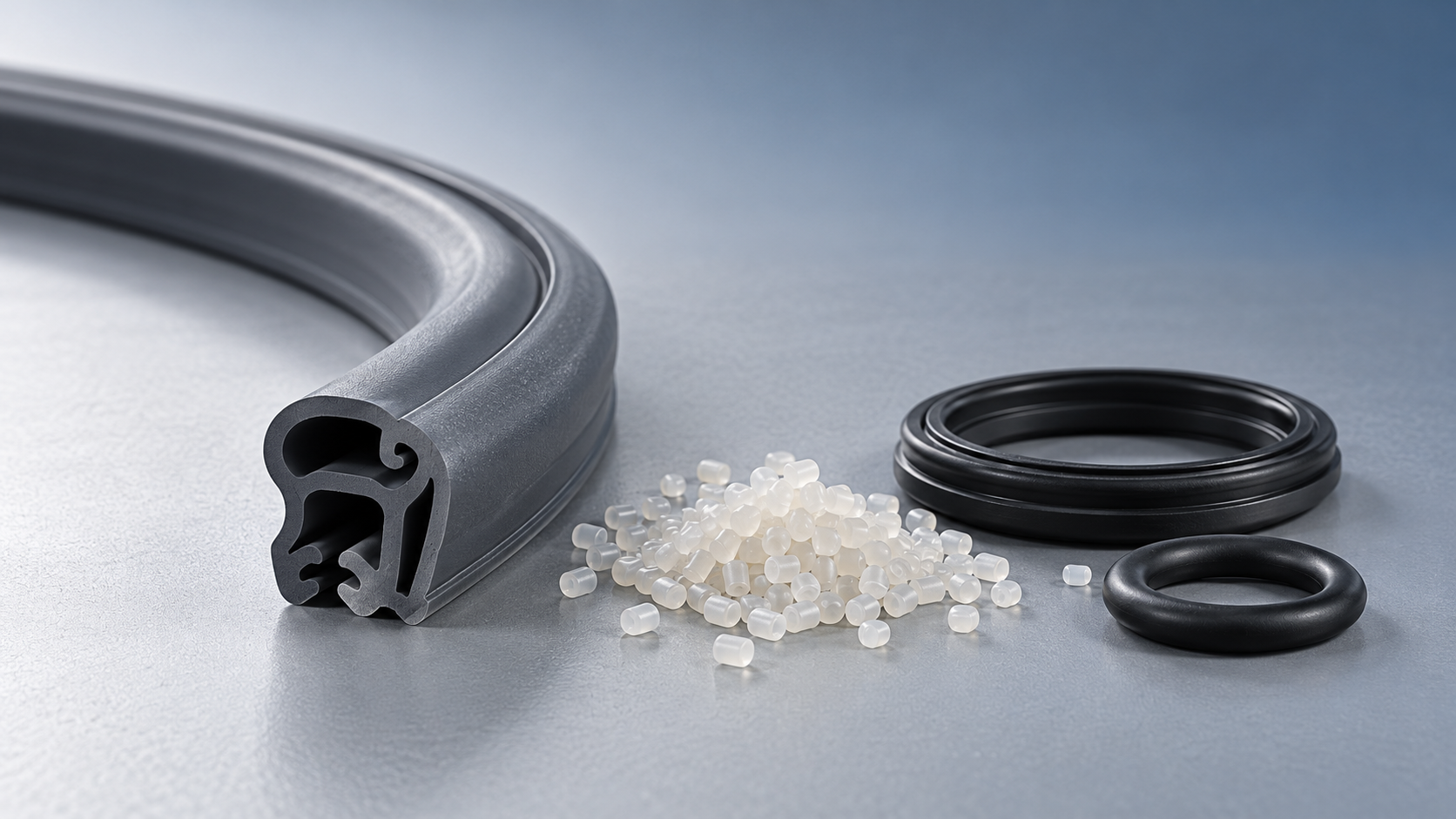
This difference matters on the factory floor. TPE processing can remove a curing operation and allow some clean production scrap to be reprocessed. Neither benefit is automatic: drying, cooling time, tooling, contamination control, and restrictions on regrind still affect the result.
“TPE” is a family, not a material specification
Two compounds sold as TPE can behave very differently. A soft grip material is not necessarily suitable for a hot-water seal, even when both have the same nominal Shore hardness.
- Styrenic TPEs, including SBS- and SEBS-based compounds: often considered for soft-touch surfaces, flexible consumer components, and selected seals. Heat resistance, oil resistance, and weatherability depend heavily on formulation.
- Thermoplastic polyurethane, or TPU: frequently chosen where abrasion resistance, toughness, and repeated flexing matter. Hydrolysis resistance and chemical compatibility vary between grades.
- TPVs: commonly evaluated for weatherstrips, flexible profiles, and sealing components requiring a balance of rubber-like behavior and thermoplastic processing.
- Thermoplastic polyester elastomers: often considered for mechanically demanding flexible components such as bellows, where fatigue behavior and temperature capability need careful assessment.
Start with the polymer family, then examine the actual grade. Hardness alone says little about recovery after prolonged compression, adhesion to another plastic, or resistance to a particular cleaning fluid.
Where replacement makes practical sense
Grips and soft-touch overmolding
Handles, tool grips, and protective contact surfaces are strong candidates because the material often provides comfort, friction, or impact cushioning rather than maintaining a pressure-tight seal. Overmolding may also reduce assembly steps. Still, adhesion must be checked against the exact substrate, surface condition, and molding process; not every TPE bonds to every rigid plastic.
Footwear and flexible protective components
Selected footwear parts, protective boots, and flexible covers can benefit from injection molding and grade-specific abrasion or flex-fatigue performance. The trade-off is application-dependent. Ground contact, repeated bending, sweat, moisture, and storage temperature can expose weaknesses that are not apparent from an initial feel test.
Seals, profiles, and selected automotive parts
TPEs can replace thermoset rubber in some dust seals, closure seals, weatherstrips, cable-management parts, and flexible interior components. For applications such as Elastic rubber seals, however, the decision should follow sealing-force retention and environmental testing—not simply a similar appearance or hardness.
A lightly compressed dust barrier and a continuously loaded hot-fluid gasket are different engineering problems. The first may suit a TPE conversion; the second may require a thermoset compound with a proven service history.
Where thermoset rubber still earns its place
Long-term heat exposure and sustained compression are common reasons to retain vulcanized rubber. Some thermoplastic elastomers soften or relax enough at elevated temperatures to lose useful contact pressure. Specialized grades can perform well, but a broad TPE designation is not evidence of suitability.
Compression set measures residual deformation after a defined compression-and-recovery procedure. It is useful, but results are only comparable when temperature, duration, specimen geometry, and recovery conditions match. Stress-relaxation testing can add a more direct view of how sealing force declines with time.
Chemical resistance creates another boundary. EPDM compounds are often considered for weathering, ozone, and suitable water-service applications, but generally not for petroleum-oil exposure. Other rubber families serve different environments. Neither thermoset rubber nor TPE should be treated as universally resistant to oils, fuels, steam, or cleaning chemicals.
Compare finished-part performance, not pellet prices
A credible substitution trial begins with the actual operating envelope: continuous and peak temperatures, media exposure, movement, compression, and expected life. Then compare candidate materials under matching conditions. Useful checks include:
- Compression set and retained sealing force after heat aging.
- Changes in volume, hardness, and strength after exposure to service fluids.
- Low-temperature flexibility, fatigue, abrasion, or tear resistance where relevant.
- Finished-part leakage, fit, assembly behavior, and applicable compliance requirements.
Processing economics belong in the same comparison. Removing a cure stage may help, but new tooling, molding-machine requirements, drying, shrinkage control, and validation costs can offset that advantage. Reprocessable factory scrap is useful; it does not mean the finished product will necessarily enter an effective recycling stream.
Keeping the rubber route open
If the existing thermoset design performs well and cost is the main concern, reformulating it may be more sensible than changing material families. EPDM reclaimed rubber can be evaluated as part of an appropriate compound, with the loading determined by processing needs and required finished properties. It is not a drop-in TPE substitute, and its use still requires compound-level validation.
Hebei Weizhong Rubber Technology, based in Xingtai, has specialized in EPDM reclaimed rubber research, production, and sales since 1986. For a reclaimed-rubber formulation discussion, useful starting information includes the current compound, target hardness, exposure conditions, and acceptance tests. Those details help establish whether a customized reclaimed-rubber route deserves evaluation alongside a TPE conversion.
Choose a TPE elastomer when its processing advantages survive the service requirements. Retain thermoset rubber when long-term recovery, environmental resistance, or validated performance makes the conversion too uncertain. The deciding evidence should come from the part under realistic conditions, not from how similar two material samples feel.
Leave A Message
If you are interested in our products and want to know more details, please leave a message here, we will reply you as soon as we can.