




Garage Door Seal Supplier Checklist: Samples, Lead Times, and Order Accuracy
A sample that fits perfectly means little if the bulk order arrives late or contains the wrong profiles. For procurement teams, choosing a garage door seals supplier requires more than comparing unit prices: sample approval, material specifications, production lead times, and order verification all affect purchasing risk. The useful question is not simply “Can you make this seal?” It is “Can you repeatedly deliver the approved seal, correctly identified, when our operation needs it?”
Use the following checks to turn a quotation into a purchasing agreement that production, quality control, and receiving teams can actually work with.
Start with the interface, not the catalog description
“Garage door bottom seal” is not a complete specification. T-end, bead-end, bulb, and other profiles are not interchangeable merely because their overall widths look similar. The retaining channel, insertion geometry, compressed height, and available clearance determine whether the seal installs and closes correctly.
Send a controlled drawing wherever possible, supported by photographs of the installed seal and its retaining channel. If only an old sample is available, identify whether it has stretched, hardened, or permanently compressed. Copying worn dimensions can reproduce a service problem rather than the original design.
- Identify the application: bottom edge, jamb, header, or threshold.
- Mark critical dimensions, including retaining features, wall thickness, and cut length.
- State whether the section is solid, sponge, or a combination.
- Describe exposure to sunlight, moisture, temperature changes, cleaning agents, or oils.
- Define acceptable installation force and closing behavior through an agreed evaluation method.
Do not apply one blanket tolerance to every dimension. Retaining features may need tighter control than a non-contact outer surface. Agree on measurement conditions as well: squeezing a flexible profile with calipers can change the result.
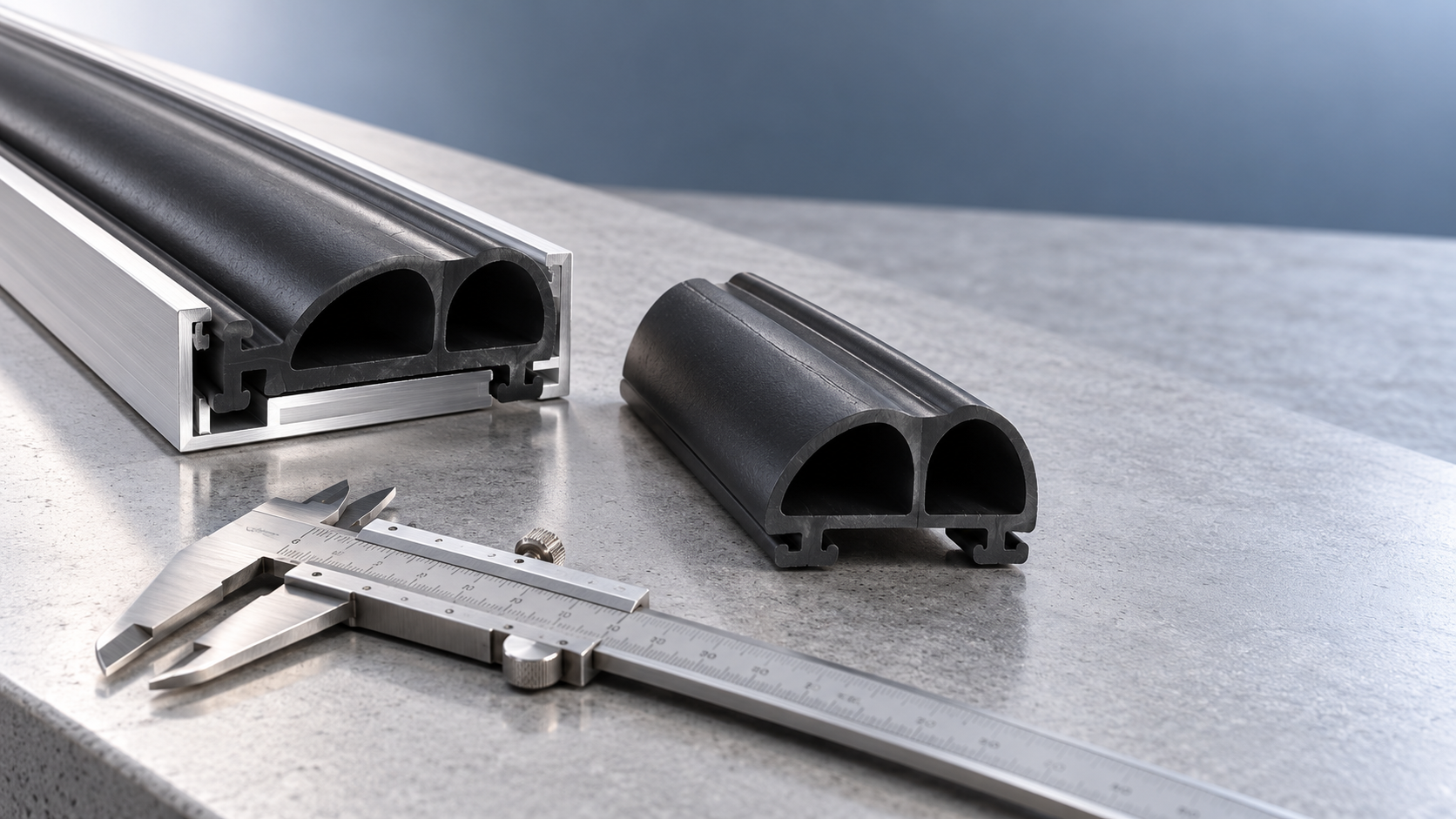
Approve a production-representative sample
Ask how the sample was produced. A hand-cut section or carefully selected development sample may demonstrate shape without proving that normal production can hold it. Confirm whether the sample uses the intended tooling, compound, curing process, and finishing method. Record any differences before approval.
Check fit on the actual retaining channel and door assembly where practical. Look beyond whether the profile slides into place. Does it remain seated during operation? Does the door close without excessive resistance? Does the seal recover after compression? Where floor unevenness matters, evaluate contact across the opening rather than at one convenient point.
Keep matching reference samples with the buyer and supplier, linked to the drawing revision and compound identification. Approval should distinguish appearance, dimensions, and functional performance. Accepting the color should not accidentally become approval of every material property.
Material names are only the starting point
EPDM is commonly considered for outdoor sealing because of its weathering and ozone resistance, but “EPDM” alone does not define a compound. Hardness, compression behavior, formulation, and processing affect the finished profile. Oil exposure may require a different material choice. Flexible PVC and thermoplastic elastomers also require application-specific evaluation rather than assumptions based on appearance.
Reclaimed rubber should be assessed through the finished compound, not accepted or rejected by label alone. Hebei Weizhong Rubber Technology, based in Xingtai, has specialized in EPDM reclaimed rubber research, production, and sales since 1986. For a material-cost review, the relevant discussion is how a proposed reclaimed-rubber formulation meets the seal’s agreed requirements. Material-supply experience does not replace finished-profile qualification.
Likewise, an adjacent product such as a High-quality rubber refrigerator door sealing strip should not be treated as proof of garage-door suitability. Appliance and exterior-door seals can have different geometry, exposure, and compression requirements; request evidence for the actual application.
Make the lead-time promise measurable
A quoted lead time is incomplete unless its starting event and finishing event are clear. Does the clock begin after deposit, drawing approval, tooling acceptance, or material availability? Does “delivery” mean production completion, carrier collection, or arrival at your warehouse?
Separate tooling development, sample approval, bulk manufacturing, inspection, packing, and transport. A standard profile and a newly tooled extrusion should not be planned as though they carry the same uncertainty. Ask which stages can overlap and which require written release.
- Record the shipment date and the agreed shipping term with its named place.
- Confirm whether the quoted capacity covers your quantity and profile mix.
- Ask how shutdowns, maintenance, and material shortages affect the schedule.
- Agree when delays must be reported and whether partial shipments need authorization.
For repeat orders, clarify whether the supplier stocks compound, unfinished profiles, or finished goods. These arrangements offer different response times and inventory risks. Any buffer-stock agreement should address storage conditions, stock rotation, ownership, and changes to the approved specification.
Prevent order errors before packing begins
Similar-looking black profiles are easy to confuse when several sizes share a shipment. Give each item a unique part number tied to its drawing revision. The purchase order, supplier acknowledgment, inspection record, and carton label should use the same identification.
Specify the purchasing unit explicitly. A price per meter is not equivalent to a price per cut piece or coil. Confirm whether lengths must be continuous, whether joints are permitted, and how short lengths or quantity variations will be handled. For coiled seals, agree on packaging that avoids damaging folds or persistent distortion.
Require written acknowledgment of profile, material designation, color, length, quantity, packaging, and delivery commitment before production. Substitutions need approval, even when the supplier considers them equivalent. Before dispatch, request inspection results against agreed acceptance criteria and labels showing part number, quantity, and batch identification.
Compare the cost of usable stock
A lower unit price can disappear through extra trimming, sorting, unusable short lengths, expedited freight, or installation rework. Compare quotations on the same scope: tooling, samples, packaging, freight responsibilities, inspection, and likely cutting waste. Where costs remain uncertain, identify them rather than treating them as zero.
Before releasing an order, assemble one approval package containing the drawing, reference-sample record, material requirements, acceptance criteria, packaging instructions, and shipment commitment. Ask the supplier to confirm it as a single baseline. If those documents disagree, resolve the discrepancy before production—not when the receiving team opens the cartons.
Leave A Message
If you are interested in our products and want to know more details, please leave a message here, we will reply you as soon as we can.