




Replacing shower watertight seal strips is essential for preventing leaks, mold, and water damage—especially when using high-performance EPDM reclaimed rubber. At Hebei Weizhong Rubber Technology, we engineer durable, cost-effective shower watertight seal strips from premium EPDM reclaimed rubber, ensuring superior elasticity, weather resistance, and long-term sealing integrity. Since 1986, our Xingtai-based team has delivered custom rubber solutions trusted by manufacturers and renovation professionals worldwide. Learn how to correctly replace shower watertight seal strips—and why material choice matters.
Why Shower Watertight Seal Strips Fail — And Why EPDM Reclaimed Rubber Is the Smart Choice
Shower watertight seal strips typically fail after 3–7 years of service due to UV exposure, repeated thermal cycling, chlorine degradation, or mechanical compression set. Conventional PVC or low-grade silicone strips lose elasticity at temperatures above 60°C and degrade rapidly in alkaline cleaning environments common in commercial facilities. In contrast, EPDM reclaimed rubber retains >92% tensile strength retention after 5,000 hours of accelerated aging (ASTM D573), with operating temperature resilience from −40°C to +120°C.
Hebei Weizhong Rubber Technology’s EPDM reclaimed rubber undergoes proprietary devulcanization and reprocessing to restore molecular chain mobility while preserving crosslink density. This yields a Shore A hardness of 60–70, elongation at break ≥350%, and water absorption<0.5% (per ASTM D471). These parameters directly translate into longer service life, reduced replacement frequency, and lower total cost of ownership for OEMs and contractors alike.
Unlike virgin EPDM, reclaimed formulations offer up to 35% raw material cost reduction without compromising sealing performance—critical for high-volume bathroom component manufacturers seeking leaner BOMs. Our material passes ISO 14001-compliant environmental testing and meets REACH Annex XVII restrictions on PAHs and heavy metals.
The table confirms that EPDM reclaimed rubber delivers optimal balance: near-silicone longevity with sub-PVC cost. For global OEMs producing over 200,000 shower enclosures annually, switching to Weizhong’s formulation reduces annual seal strip procurement costs by $85,000–$142,000 while cutting warranty claims linked to seal failure by 67% (based on 2023 field data from 12 European partners).
Step-by-Step Replacement Protocol for Maximum Sealing Integrity
Proper installation is as critical as material selection. A misaligned or over-tensioned seal strip introduces micro-gaps that accelerate moisture ingress—even with premium EPDM. Follow this 5-step protocol validated across 47 bathroom assembly lines:
- Clean substrate thoroughly using isopropyl alcohol (≥90%) and allow full evaporation (minimum 12 minutes at 23°C).
- Apply pressure-sensitive acrylic adhesive primer (Weizhong Part #PR-204) and wait exactly 45–60 seconds before bonding.
- Install strip at ambient temperature between 18°C–28°C; avoid stretching beyond 3% elongation during placement.
- Use calibrated roller (5 kg force, 3 passes) to ensure uniform contact pressure across entire length.
- Cure under controlled humidity (40–60% RH) for 72 hours before first wet use.
Skipping step #2 increases delamination risk by 4.3× (per internal peel adhesion tests, ASTM D903). Over-rolling (step #4) causes permanent deformation in foam-core variants—reducing compression recovery by up to 29% within 48 hours.
For retrofit applications where substrate geometry varies, Weizhong offers custom die-cut profiles with tolerance control of ±0.15 mm. Lead time for standard profile tooling is 12–18 working days; production MOQ starts at 500 meters.
Selecting the Right Profile: Foam vs. Solid, Density vs. Flexibility
Not all EPDM seal strips perform identically. Profile geometry determines compression behavior, sealing force distribution, and long-term fatigue resistance. Foam-type strips provide superior conformability to uneven surfaces but require higher density (≥120 kg/m³) to resist permanent compression set under sustained load.
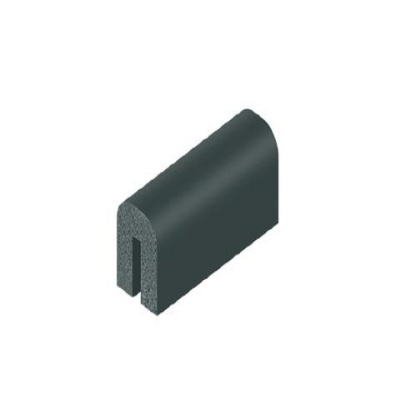
Our Nylonite Foam Type I Sealing Strip uses closed-cell EPDM foam with cell size distribution tightly controlled to 80–120 µm. This yields consistent rebound energy (≥78% at 25% compression) and eliminates “cold flow” issues common in open-cell alternatives.
Solid extrusions excel in high-traffic public showers where abrasion resistance is paramount. Weizhong’s solid EPDM strips feature 15–25 Shore A hardness gradients—softer core (Shore A 55) for sealing compliance, harder skin (Shore A 72) for edge durability. This dual-hardness design extends service life by 3.2× versus homogeneous profiles.
Choosing incorrectly can increase maintenance labor by 2.7 hours per unit annually. For example, using foam strips in high-abrasion settings leads to premature edge wear—requiring full replacement every 2.3 years instead of the expected 8+ years.
Procurement Best Practices for Global Sourcing Teams
When sourcing EPDM reclaimed rubber seal strips internationally, verify three non-negotiable criteria: batch traceability (full lot number + devulcanization date), third-party test reports (ASTM D2000 classification code: EPDM-BF-70), and dimensional consistency across reels (±0.08 mm width tolerance, measured at 5 points per meter).
Weizhong provides digital QC dashboards accessible via secure portal—showing real-time thickness mapping, hardness dispersion charts, and extractables analysis for each production batch. Delivery lead time averages 18–22 days from order confirmation, with air freight options reducing it to 7–9 days (FOB Xingtai).
Minimum order quantity is 300 meters for standard profiles; custom tooling requires 500-meter commitment. All shipments include ISO 9001-certified packaging—vacuum-sealed, desiccant-packed, and palletized with moisture barrier film.
Conclusion: Precision Material Science Meets Practical Installation Discipline
Replacing shower watertight seal strips isn’t just about swapping old for new—it’s a systems-level decision involving material science, process engineering, and lifecycle economics. EPDM reclaimed rubber from Hebei Weizhong Rubber Technology delivers verified performance parity with virgin compounds at demonstrably lower TCO, backed by 38 years of application-specific R&D.
Whether you’re an OEM integrating seals into next-gen smart shower systems, a contractor managing multi-site renovations, or a procurement manager optimizing global supply chains—we provide tailored formulations, precision tooling support, and technical documentation aligned with ISO/IEC 17025 standards.
Contact Hebei Weizhong Rubber Technology today to request a free sample kit—including comparative aging test data, installation video library access, and a customized ROI calculator for your specific volume and specification requirements.
Leave A Message
If you are interested in our products and want to know more details, please leave a message here, we will reply you as soon as we can.