




NBR sealing strips are a practical choice for many oil-exposed joints, but an “oil-resistant” label does not establish whether a strip will keep sealing. Approval should depend on how the specific compound responds to the actual fluid, how much recovery it retains under compression, and whether it survives the temperatures experienced at the joint.
A strip can swell without immediately leaking, yet become too soft to resist displacement. Another may show little dimensional change while hardening enough to lose contact as the joint moves. Reliable selection therefore requires a combined assessment of fluid compatibility, temperature exposure, and sealing geometry.
Define the oil exposure before comparing materials
“Oil” is too broad a specification for material selection. Mineral lubricants, synthetic lubricants, hydraulic fluids, and metalworking fluids can behave differently against the same NBR compound. Additives, cleaning residues, water contamination, and changes during service can also affect the result.
Record the fluid’s exact product designation and whether the strip sees continuous immersion, intermittent splashing, oil mist, or occasional spills. Include cleaning chemicals if they contact the seal. A strip that tolerates its operating lubricant may still deteriorate during maintenance washing.
NBR formulations also differ. Acrylonitrile content influences oil resistance and low-temperature flexibility, while fillers, plasticizers, and the cure system affect hardness, aging, and compression behavior. Higher acrylonitrile content generally improves resistance to many hydrocarbon oils, but can reduce flexibility in cold conditions. The polymer name alone cannot resolve that tradeoff.
Use compatibility charts to screen candidates, then assess the proposed production compound. Results for a different NBR grade, hardness, or manufacturing process provide background rather than approval evidence.
Read swell results alongside changes in strength and hardness
Volume swell measures how much a specimen changes in volume after fluid exposure. Oil entering the rubber can expand and soften it. Conversely, fluid can extract soluble ingredients, causing shrinkage or hardening. These processes may occur together, so a small net volume change does not necessarily mean the compound remained unaffected.
The immersion report should identify the fluid, exposure temperature, duration, specimen preparation, and measurement procedure. Measurements taken after different cooling or recovery periods may not be directly comparable. Samples should be handled consistently so that surface oil does not distort mass measurements.
Evaluate retained properties against their starting values and the application’s requirements. A favorable percentage retention can still leave a weak compound below the strength needed for installation or service. Likewise, an acceptable final hardness does not erase evidence of a substantial change during exposure.
Translate swelling into what happens inside the joint
There is no universal acceptable swell percentage for NBR sealing strips. The same dimensional change can have different consequences in an open flange joint and a tightly confined groove.
In a confined groove, swelling consumes free space. If the rubber has insufficient room to expand, closure loads can rise and material may be forced into clearances. Softening increases the risk of extrusion or displacement under pressure. In a less confined joint, swelling may initially increase contact, but the strip can still roll, distort, or lose stability.
Shrinkage presents a different problem: it can reduce the interference that creates sealing pressure. An assembly may remain dry while warm and swollen, then leak after cooling or draining as the strip contracts.
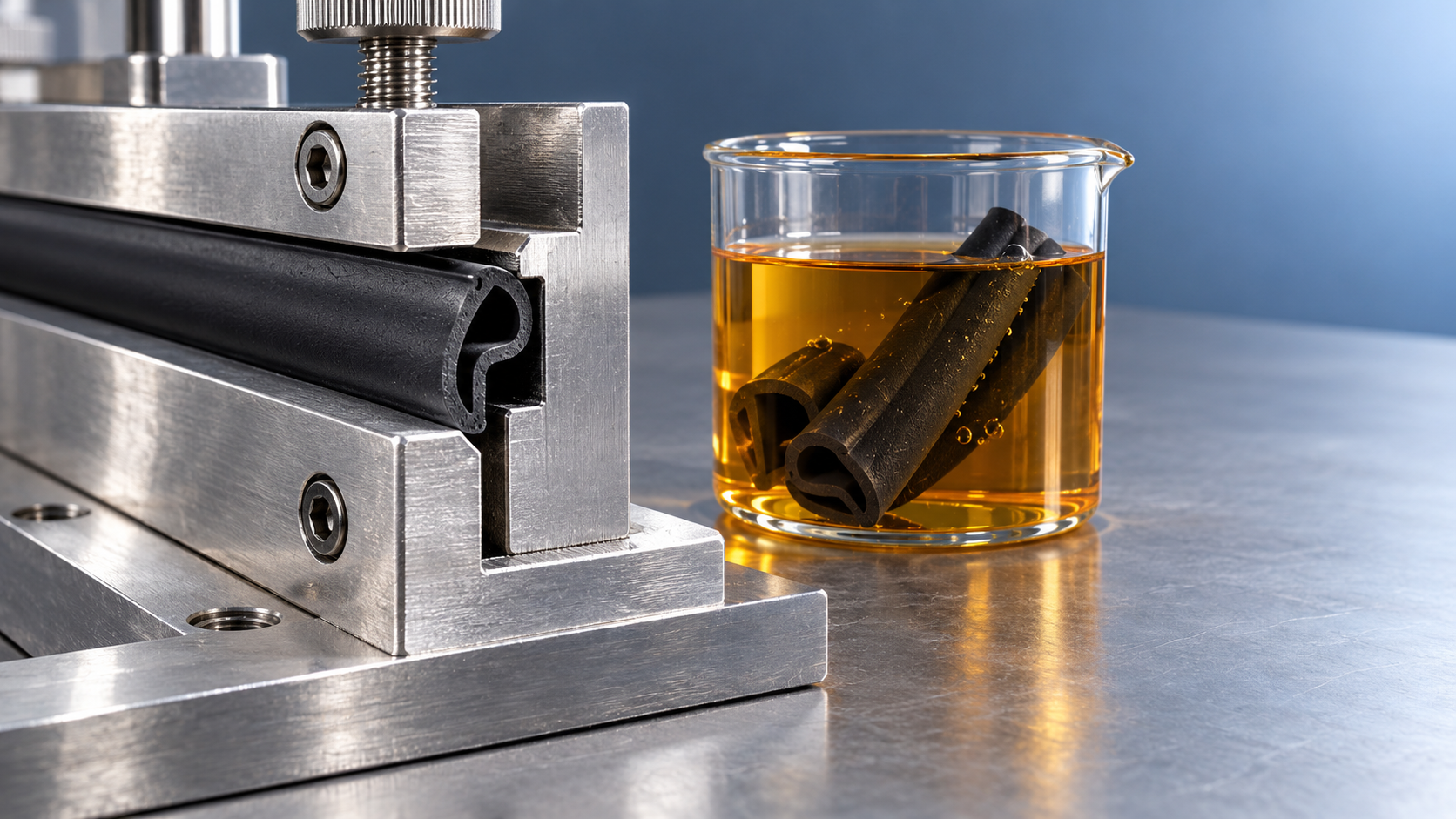
Use the exposed strip dimensions to reassess groove fill, squeeze, closure force, and available clearance. Do not assume volume change translates directly into the same percentage increase in thickness. Free specimens and constrained profiles deform differently, and hollow sections need particular attention because wall movement affects their sealing force.
Where movement, pressure, or tight confinement matters, test a representative assembled joint. Immersion specimens help explain material behavior; the assembly establishes whether that behavior remains acceptable in the design.
Check continuous heat, short peaks, and cold starts separately
A generic NBR temperature range is a screening guide. It does not establish the service life of a particular compound in a particular oil. Thermal aging and fluid interaction occur together, and higher temperatures can accelerate softening, hardening, loss of strength, and permanent deformation.
Identify the temperature at the sealing interface. Bulk oil temperature may miss local heating near a bearing, motor, or hot housing. Include normal operating conditions, startup, shutdown heat soak, and foreseeable excursions.
Continuous service requires evidence from sustained exposure at representative conditions. A short peak requires its own definition: temperature, duration, frequency, and whether the joint is loaded or pressurized during the event. Repeated excursions can accumulate damage even when each event is brief.
Cold performance also belongs in the assessment. A strip that seals well when warm may become too stiff to follow flange movement during startup. Where the operating range is broad, check whether the oil-resistant formulation retains enough low-temperature flexibility for the joint.
Accelerated hot immersion can help compare candidates, but raising the test temperature may change the degradation mechanism. Do not convert a short, hotter test directly into a service-life claim without a validated relationship.
Test the finished strip under realistic compression
Free immersion leaves out the sustained deformation experienced by an installed seal. Compression set describes how much deformation remains after a compressed specimen is released. Stress relaxation describes the loss of sealing force while compression is maintained. Both matter, especially where the joint has little ability to compensate for declining contact pressure.
For demanding applications, combine fluid exposure with representative compression and temperature cycling. Include pressure cycling or movement where relevant. Assess leakage during operation and after cooling, because an assembly can pass at one condition and fail during transition.
Test the supplied profile as well as standard specimens where practical. Extrusion quality, dimensional tolerances, cut ends, and spliced corners can influence performance. Adhesive backing requires separate attention: its resistance to oil and heat cannot be inferred from the NBR face material.
Profile geometry also does not establish material equivalence. A PVC Rounded Chamfer Strip should not be treated as an alternative oil seal merely because its shape appears suitable; that decision requires its own material and application evidence.
Set acceptance criteria before approving the compound
Define pass conditions around the joint’s failure modes before reviewing results. This prevents a convenient test result from becoming an acceptance limit after the fact.
- Dimensional stability: exposed dimensions must preserve adequate squeeze, clearance, and expansion space.
- Mechanical condition: hardness, strength, elongation, and surface condition must remain suitable for installation and operation.
- Sealing performance: the assembled joint must meet its leakage requirement through relevant temperatures, pressures, and transitions.
- Production consistency: approval must identify the compound, profile, tolerances, and manufacturing route covered by the evaluation.
If a candidate fails, use the failure mechanism to guide the next choice. Excessive swell calls for better fluid compatibility or revised confinement. Heat-related loss of recovery may justify assessing HNBR or FKM, with their own fluid and cold-temperature checks. Tearing at a corner may require a profile or joint-design change.
The approval package should connect the exact fluid and operating conditions to material results and an assembly test. That connection makes the decision useful when a lubricant changes, a hotter operating cycle is introduced, or a replacement strip is proposed.
Leave A Message
If you are interested in our products and want to know more details, please leave a message here, we will reply you as soon as we can.