




Choosing between solid and sponge EPDM rubber strips starts with compression behavior. The right material must maintain sealing contact across tolerances without exceeding available closing force.
Solid EPDM generally provides firmer support, while sponge EPDM accommodates gap variation under lower loads. Profile geometry, compound formulation, and installation conditions can change that comparison.
For technical evaluators, selection should connect four variables: minimum and maximum gap, allowable closure force, recovery after sustained compression, and exposure to weather, fluids, or temperature.
Start with the joint’s operating limits, then compare supplier data under matching conditions. Strip thickness alone cannot establish whether an assembly will seal reliably over time.
What Changes When You Compress Solid or Sponge EPDM?
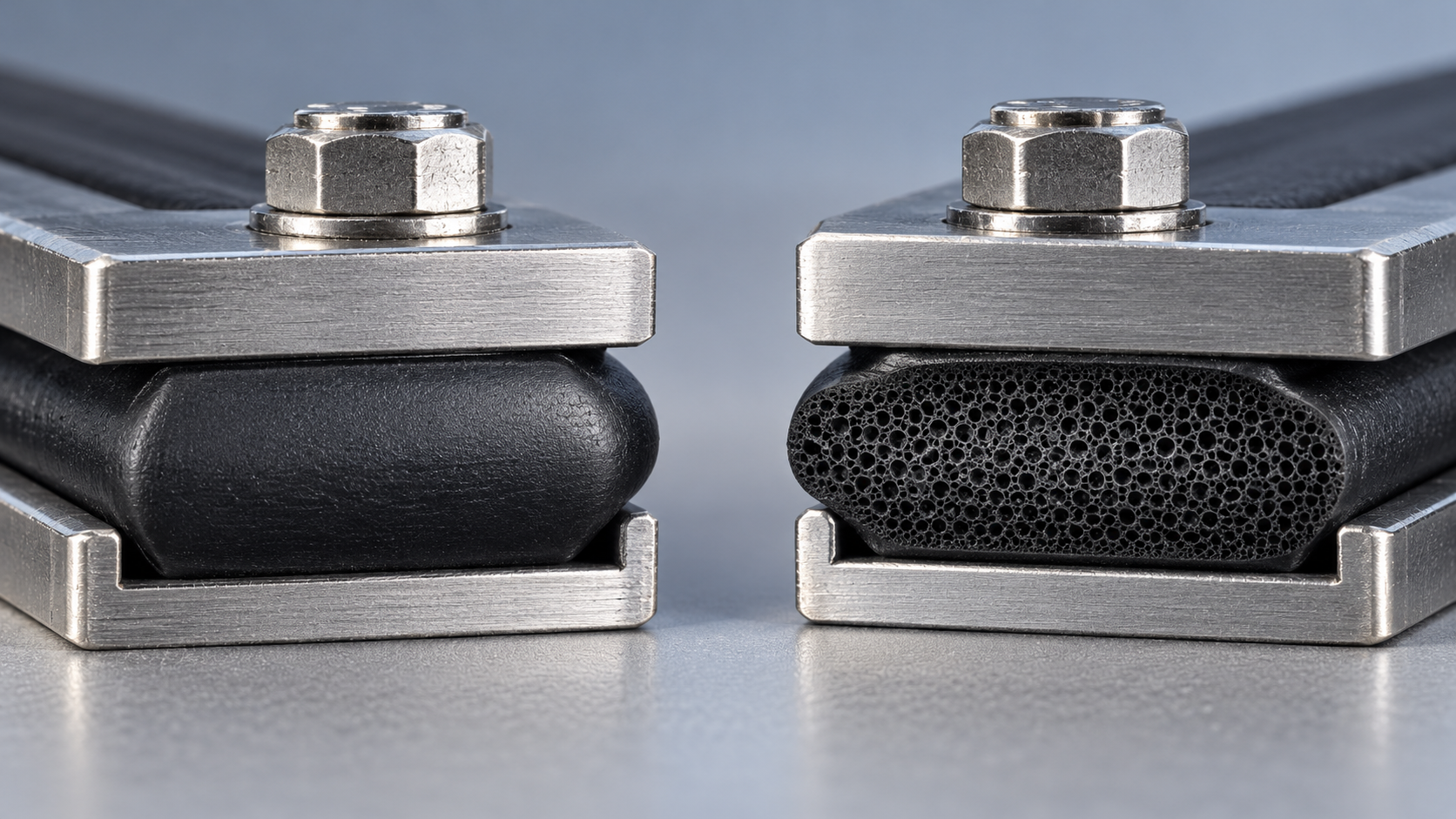
Solid EPDM is dense and nearly incompressible in volume. When squeezed, it must deform sideways, so confinement and contact geometry strongly influence the required force.
A wide, flat solid strip trapped between rigid surfaces can become difficult to compress. A hollow or lip profile can behave differently despite using solid rubber.
Sponge EPDM compresses primarily through deformation of its cellular structure. This usually provides greater deflection under lower loads, making it useful for uneven or lightweight closures.
However, cellular structure matters. Closed-cell sponge is commonly considered for weather sealing, while open-cell materials generally allow easier passage of air and water through interconnected cells.
Closed-cell construction does not automatically guarantee waterproof performance. Cut surfaces, joints, mounting details, compression level, and the complete assembly still determine the actual leakage resistance achieved.
Calculate Compression at Both Gap Extremes
Measure the installed gap around the entire sealing path. Include panel flatness, hinge movement, manufacturing tolerances, thermal expansion, and deflection caused by fasteners or latches.
For a simple rectangular strip, compression percentage equals free thickness minus closed gap, divided by free thickness, multiplied by 100. Use consistent units throughout the calculation.
For example, an 8 mm strip closing into a 6 mm gap experiences 25% compression. At a 5 mm gap, its compression increases to 37.5%.
Those nominal values can conceal significant variation. If strip thickness ranges from 7.5 to 8.5 mm, the same joint produces a substantially wider compression window.
At the largest gap, the thinnest strip compresses 20%. At the smallest gap, the thickest strip compresses approximately 41%, potentially changing closure force and durability.
Compare both extremes with the supplier’s recommended working range for that exact grade and profile. There is no universal compression percentage suitable for every EPDM seal.
Insufficient compression can leave local leakage paths. Excessive compression can increase permanent deformation, overload hardware, distort panels, or damage cellular material during repeated closure cycles.
Will Your Latches and Panels Deliver Enough Force?
Request compression force data at the expected deflections. Hardness alone cannot predict closing effort, and sponge density alone cannot establish the force required to seal.
For solid rubber, Shore A hardness provides useful compound information. Sponge materials need appropriate cellular material measurements; hardness values from different scales are not directly interchangeable.
Ask for test conditions alongside every result, including specimen dimensions, compression speed, temperature, and dwell time. Otherwise, apparently comparable figures may describe different material responses.
As a preliminary estimate, multiply compressive stress at the target deflection by loaded area. For extruded profiles, supplier force per unit length may be more useful.
For example, 30 kPa acting over 0.01 square meters produces approximately 300 N. This estimate excludes hinge geometry, friction, uneven loading, and other assembly effects.
Check whether available latch force distributes evenly around the perimeter. Adequate total force cannot compensate for a flexible cover that bows between widely spaced fastening points.
If closing effort is excessive, consider reducing contact width, changing profile geometry, or selecting a softer cellular grade. Increasing latch force alone may worsen panel distortion.
Will the Seal Recover After Months Under Compression?
Compression set measures residual deformation after a specified compression, exposure, and recovery procedure. Lower reported values generally indicate better recovery under those particular test conditions.
Compare results only when temperature, duration, compression level, recovery time, and test method align. ASTM D395 and ASTM D1056 address different material categories and procedures.
Compression set does not directly measure retained sealing force. A strip may remain visibly compressed while its contact pressure declines through stress relaxation during prolonged service.
For continuously closed equipment, request stress relaxation data where available. For frequently opened doors, evaluate recovery speed, repeated cycling, surface wear, and adhesion to mating surfaces.
Test samples after realistic thermal aging and fluid exposure. Room temperature measurements alone may miss stiffening, softening, or permanent deformation that develops during actual operation.
Check Exposure, Mounting, and Material Consistency
EPDM generally offers strong resistance to ozone, weathering, and many water-based environments. It is commonly unsuitable for petroleum oils and fuels unless compatibility is specifically demonstrated.
Verify the exact compound against service temperature, cleaning agents, steam, and any process fluids. Generic EPDM temperature claims should not replace grade-specific continuous service limits.
Adhesive backing also needs evaluation. Surface preparation, substrate chemistry, moisture, installation temperature, and sustained peel forces can determine whether an otherwise suitable strip remains securely positioned.
Inspect corners and strip joints because discontinuities often dominate leakage. Where performance demands justify it, consider molded corners, joined frames, or validated bonding methods for continuity.
Related sheet products, including a Multi-functional rubber mat, require separate evaluation. Their suitability for cushioning or surface protection does not establish performance as a compressed sealing strip.
What Should a Technical Purchase Specification Include?
Specify material type, cellular structure where applicable, profile dimensions and tolerances, operating gap range, target compression window, and maximum acceptable closure force for the assembled joint.
Also define compression set conditions, environmental exposure, joint construction, adhesive requirements, and relevant leakage acceptance criteria. Include applicable certification requirements only when the application needs them.
Validate candidate strips in representative assemblies at tolerance extremes. Measure closure effort, inspect contact continuity, and repeat leakage checks after aging and opening cycles appropriate to service.
For reclaimed-rubber formulations, evaluate the finished compound and production consistency. Reclaimed content alone does not establish seal performance; formulation, processing, and quality controls remain decisive factors.
Hebei Weizhong Rubber Technology has specialized in EPDM reclaimed rubber research, production, and sales since 1986. Based in Xingtai, it offers custom reclaimed rubber material solutions.
When discussing material options, provide compression targets, exposure conditions, and acceptance criteria. Confirm separately how the proposed material will be compounded, processed, and validated for sealing.
Choose the Strip That Fits the Entire Operating Window
Choose solid EPDM where firm contact and controlled geometry suit the joint. Consider sponge EPDM where lower closing loads and accommodation of gap variation are priorities.
Make the final decision using tolerance calculations, measured force, and aged assembly performance. A reliable seal maintains sufficient contact throughout service while allowing the hardware to operate.