




Reclaimed EPDM is suitable for a seal compound only when its cure response remains compatible with the processing window and the finished seal meets its service requirements. A matching hardness or rheometer cure time alone does not establish equivalence. Qualification needs to connect incoming material variation with scorch safety, compound flow, crosslink development, and compression set under relevant exposure conditions.
For EPDM Reclaimed Rubber Solutions, the most useful starting point is a controlled comparison against an approved compound. Keep mixing conditions, specimen preparation, and test settings consistent so that differences in the reclaim remain distinguishable from differences introduced during processing.
Residual crosslinks change what a replacement level means
Reclaimed EPDM contains rubber that has already been compounded and vulcanized. Reclaiming disrupts part of that network, but the resulting material retains crosslinked structures alongside more mobile polymer fractions, inherited fillers, oils, and other ingredients. Its behavior therefore differs from that of virgin EPDM at the same added mass.
A replacement expressed only as a percentage of total compound weight hides this distinction. Replacing virgin polymer with reclaim also introduces nonpolymer ingredients and changes the balance of fresh rubber, filler, and oil. Where composition data are available, calculate the formulation on a consistent rubber basis and account for inherited ingredients separately. Where those data are incomplete, treat the reclaim as a qualified compound ingredient with an experimentally established loading range.
Residual network structure also affects dispersion. Coarse or poorly incorporated particles can create local differences in deformation and surface quality even when average hardness remains acceptable. Conversely, a smoother-looking compound does not prove that its network will retain sealing force during prolonged compression.
Read the cure curve beyond a single reported value
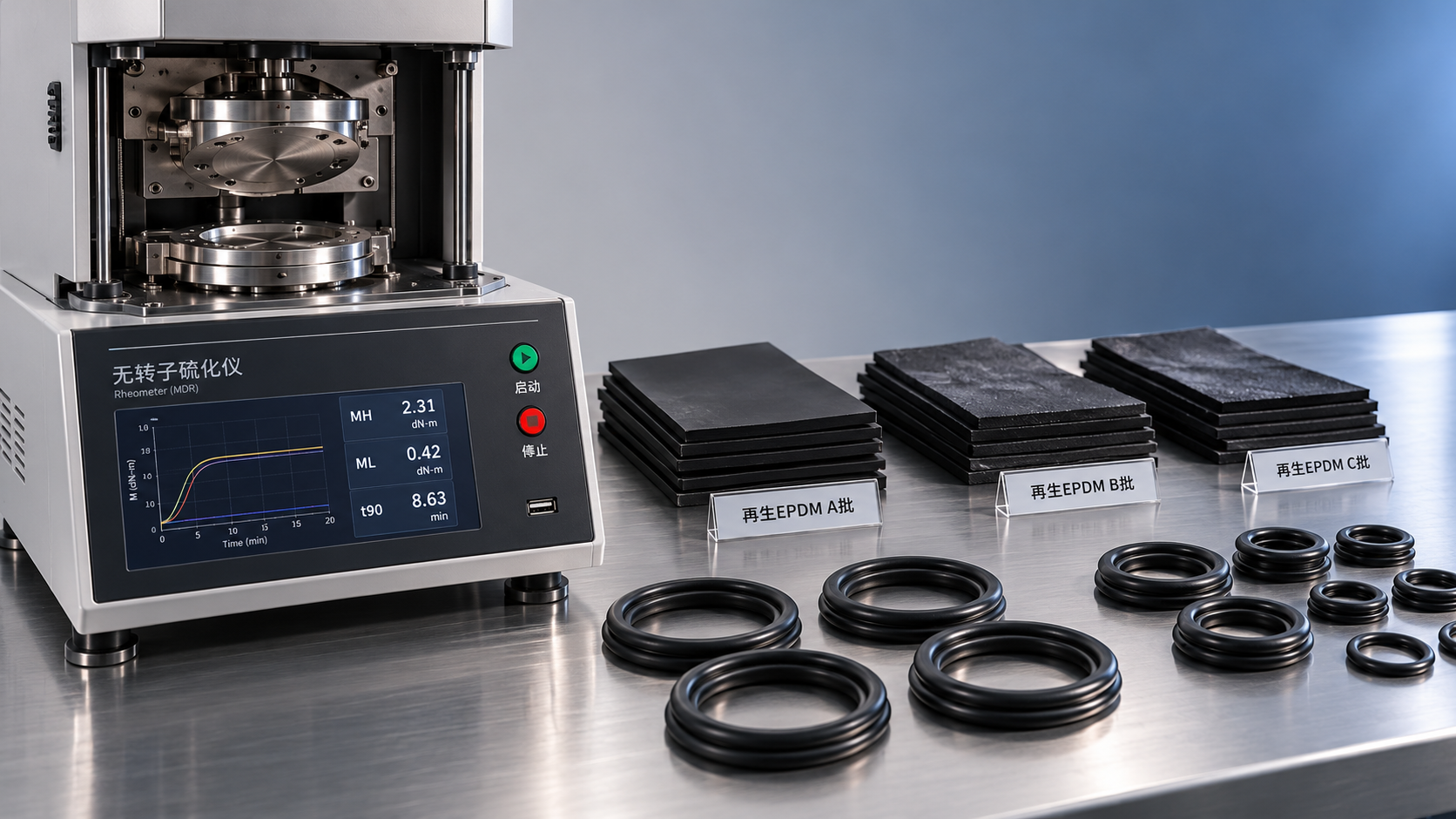
Moving-die rheometer results are comparable only when temperature, oscillation conditions, test duration, and specimen handling are controlled. Record the full curve alongside minimum torque, maximum or defined terminal torque, scorch indication, and selected cure times. A short test can conceal late torque rise or reversion, producing a misleading picture of the available cure window.
The torque increment, often expressed as maximum torque minus minimum torque, is useful for tracking a fixed formulation. It is not a direct measurement of newly formed crosslinks. Filler structure, viscosity, residual gel, and dispersion all contribute to the measured response.
A reported t90 is relative to the torque development measured in that test. Two compounds can reach t90 at similar times while developing different torque increments and different seal properties. The rheometer specimen also heats differently from a thick molded section, so its cure time cannot be transferred directly to a production press cycle.
Separate scorch safety from final cure performance
Scorch concerns begin before the mold reaches its curing conditions. Warm storage, repeated milling, extrusion, and delays between mixing and molding contribute to the compound’s thermal history. A formulation with acceptable rheometer scorch behavior at cure temperature can still lose processing latitude during a prolonged warm operation.
Assess processing-temperature scorch or viscosity stability under conditions relevant to the actual route. Record mixing sequence, discharge temperature, cooling, and rest time. Without these controls, an apparent reclaim-lot effect may actually reflect different treatment of the compound.
The cure system sets further boundaries. In sulfur-cured EPDM, inherited sulfur-bearing ingredients and accelerator residues can alter induction time and cure progression. In peroxide-cured formulations, inherited ingredients and polymer degradation can affect radical efficiency and the resulting network. A reclaim qualified in one cure system has no automatic qualification in the other.
Adding accelerator to restore a delayed cure can shorten scorch safety. Increasing peroxide to recover torque can change hardness and elongation without resolving poor dispersion or incorrect polymer accounting. Establish the cause of the shift before adjusting the cure package, then verify both processing latitude and cured properties.
Use incoming measurements that explain production variation
Incoming control works best when each measurement addresses a known source of variation. Ash content provides an indicator of inorganic residue, but it does not identify all filler types or describe reinforcement. Extractable content reflects soluble ingredients under the chosen method; it should not automatically be interpreted as oil content. Moisture and volatile matter require defined methods because they can affect both processing behavior and test interpretation.
Viscosity measurements need particular care with reclaim containing substantial gel. Sample preparation and the selected procedure influence the result. Consistency under an agreed method is more useful than comparing values generated by incompatible methods.
A small reference compound is often more revealing than isolated raw-material numbers. Use a fixed formulation and mixing procedure, then compare cure behavior with a retained, approved reclaim lot. This captures combined effects that separate compositional tests miss. Retained samples need controlled storage and a defined useful comparison period because aging can change their behavior.
Qualification should include independent production lots. Repeated tests from one delivery establish measurement repeatability; they provide limited evidence about variation between batches. Establish acceptance ranges from demonstrated process capability and seal performance, with separate handling for an unusual trend that remains inside individual numerical limits.
Connect laboratory results to the seal’s deformation and exposure
Compression set is directly relevant to seals, but its meaning depends on specimen geometry, compression, temperature, duration, and recovery conditions. Compare results only under matched conditions. A low value measured after a mild exposure does not establish suitability for a hotter or longer service interval.
Hardness and tensile strength remain useful supporting properties. Neither measures retained contact force. Stress-relaxation testing under compression provides additional information where sustained sealing force matters, while fluid aging and thermal aging reveal changes that initial cure measurements cannot predict.
Evaluate molded seals for surface defects, flash behavior, dimensional stability, and leakage under the intended assembly conditions. Excessive flash can result from viscosity or mold conditions as well as cure timing. Cracks near a parting line require examination of dispersion, demolding strain, and local geometry before attributing them to insufficient cure.
Where a seal sits beside a protective component such as Silicone Cable Wire Wrap Protector Sleeves, keep material specifications separate. The adjacent component’s temperature rating does not establish the EPDM seal’s compression-set resistance or fluid compatibility. Test contact effects when migration or sustained direct contact is relevant to the assembly.
Make formulation changes traceable
Begin a reclaim-loading study with an approved baseline and hold the cure package constant for the initial comparison. Correct documented filler and oil contributions where sufficient composition data exist. This exposes the reclaim’s effect before cure adjustments obscure it. Then change one relevant variable at a time and retain the corresponding mixing and molding records.
The practical release boundary is the overlap between acceptable processing and acceptable seal performance. If a batch needs a different cure package or molding cycle to pass, record it as a formulation or process change requiring validation. Quietly compensating for each delivery prevents meaningful batch comparison and leaves the production window undefined.
Leave A Message
If you are interested in our products and want to know more details, please leave a message here, we will reply you as soon as we can.