




A rubber hose may arrive with a clean cover, readable branding, and a passing test certificate yet still be unsuitable for the intended service. Acceptance requires three things to agree: the pressure rating must cover the operating conditions, the markings must identify the supplied hose, and the test records must demonstrate the required compliance. A mismatch is grounds to hold the shipment before installation, not something to resolve after startup.
For rubber hose selection, begin with the approved service specification rather than the largest pressure number on the paperwork. Confusing proof pressure with working pressure, overlooking temperature limits, or accepting a report for a different construction can allow an unsuitable assembly into service, creating risks of leakage, coupling separation, and unplanned shutdowns.
Establish the acceptance basis before inspecting the delivery
The purchase specification should identify the fluid, operating temperature range, maximum operating pressure including foreseeable surges, hose size, connection details, and applicable product standard with its edition. It should also define whether acceptance covers bulk hose or complete hose assemblies. A hose-only certificate does not automatically establish the suitability of the installed fittings or the assembly process.
Standards must match the application. ISO 1402 describes hydrostatic testing methods for rubber and plastics hoses and assemblies; it does not, by itself, establish every service-specific acceptance requirement. Product standards, such as ISO 18752 for certain hydraulic hose types, address different requirements. Check the exact scope, classification, and contractual edition rather than treating a familiar standard number as universal approval.
Where the order says only “industrial rubber hose” or “high-pressure hose,” obtain a clarified specification before release. Without an agreed acceptance basis, an inspector cannot reliably decide whether the markings, test pressure, or reported results are sufficient.
Separate working pressure from proof and burst pressure
The pressure printed most prominently on a report may describe a test condition rather than an allowable service condition. Read the term attached to the value and verify the units.
The assembly rating cannot exceed the lowest applicable rating of its components, and assembly-specific restrictions may lower it further. Check the hose, couplings, adapters, and connection configuration together. Do not calculate working pressure from a burst result unless the governing specification explicitly establishes that relationship.
Temperature derating also needs a documented basis. A room-temperature pressure rating may not apply near a hot process line. Check fluid compatibility separately: swelling, hardening, or deterioration of the lining can make a hose unsuitable even when its nominal pressure rating appears adequate. Vacuum service requires its own suitability check; positive-pressure capability does not establish collapse resistance.
Read the markings as a traceability record
Compare the hose layline, assembly tag, packaging label, and delivery documents. Depending on the governing specification, required information may include manufacturer identification, hose designation, nominal size, pressure rating, standard reference, and a production date or batch code. Not every standard requires the same marking fields, so inspect against the actual requirement rather than a generic list.
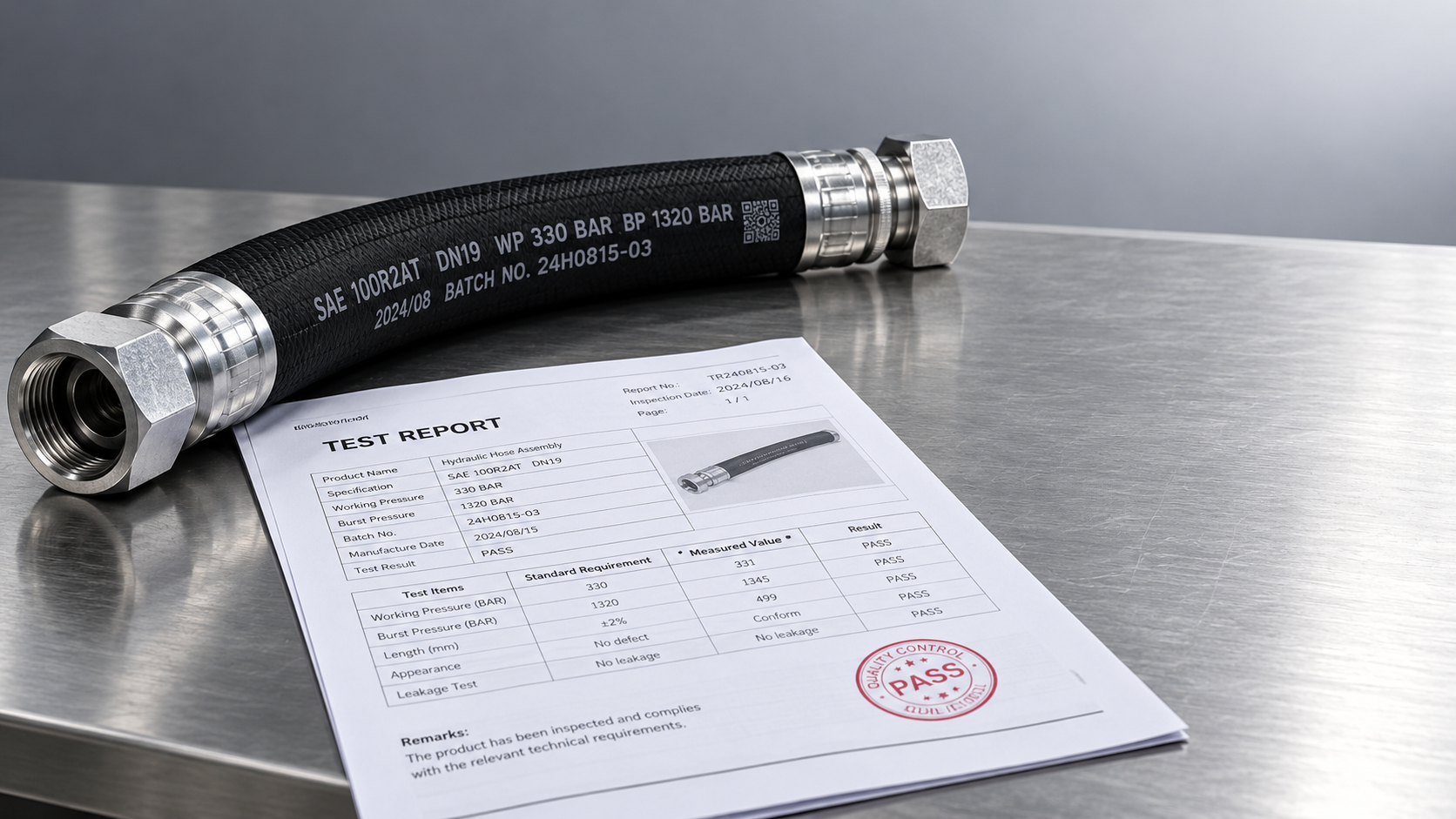
A practical inspection follows the identity chain:
- Match the designation. Confirm that the hose type, size, and construction correspond to the purchase order and approved technical data.
- Check pressure notation. Distinguish working-pressure markings from other numbers and reconcile bar, MPa, or psi where necessary.
- Record traceability codes. Link the delivered batch or assembly serial number to the relevant certificate and test record.
- Inspect legibility and consistency. Missing sections, conflicting labels, or unexplained changes along a length require clarification.
Cut lengths may not retain every repeated layline element. In that case, use the supplier’s documented identification method and the contractual requirements to determine whether traceability remains adequate. Do not invent replacement markings or assume the packaging label proves the identity of every loose piece.
Keep pressure-hose documentation separate from records for non-pressure sealing products. For example, Garage Door Top and Side Sealing Strips belong to a different product category; their documentation cannot substitute for evidence required for a pressure-hose assembly.
Decide what the test report actually proves
A certificate of conformity states that requirements have been met. A test report records evidence from specified tests. Either may be required, but they serve different purposes. A document headed “test certificate” should not be accepted solely because it contains a stamp or signature.
First establish the report’s scope. Does it cover the delivered assemblies, a sample from the production batch, or an earlier type-qualification test? Type testing can support a design’s qualification, but it does not automatically replace production acceptance testing required by the order.
Check for the following information where relevant to the specified test:
- Report identifier, issuing organization, test date, and authorization.
- Hose designation, dimensions, batch or serial references, and sample quantity.
- Test method, applicable specification and edition, and acceptance criteria.
- Actual test conditions, including pressure, duration, medium, and temperature where required.
- Results, observations, and any deviations from the prescribed method.
“Passed” without a stated criterion is weak evidence. For a hydrostatic proof test, confirm that the pressure and hold time match the governing requirement and that required observations were recorded. Depending on the specification, these may include leakage, damage, or dimensional change.
Check measuring-equipment calibration status at the time of testing when the acceptance plan requires it. If accredited testing is specified, verify that the laboratory’s accreditation scope covers the relevant method. Accreditation alone does not establish product certification or approval for the intended service.
Use physical inspection to challenge the paperwork
Document agreement does not eliminate the need to examine the delivery. Look for cuts, exposed reinforcement, blisters, flattening, kinks, damaged threads, corrosion, and displaced fittings. Verify dimensions and assembly length against the approved drawing, and check minimum bend-radius requirements against the intended routing.
Inspect coupling identification and assembly details where accessible. A report for the hose material cannot confirm that an undocumented coupling combination is suitable. Suspected fitting movement or an incorrect connection is a hold condition even when the pressure-test record shows a pass.
Do not improvise a receiving-area pressure test to settle doubts. Testing requires a specified procedure, suitable equipment, controlled access, and trained personnel. Pneumatic testing introduces substantial stored-energy hazards and must not be substituted casually for a specified hydrostatic method. Passing another test also cannot establish unknown material compatibility or restore missing traceability.
Record the release decision and unresolved gaps
Release the delivery only when identity, service suitability, physical condition, and required evidence agree. Record the reviewed document revisions, inspection findings, and batch or serial references so the decision remains traceable after installation.
Place unresolved deliveries on hold with a precise reason: an unverified temperature rating, a mismatched batch number, a missing assembly test, or an unsupported fitting combination. Request corrected evidence or an authorized technical disposition against the purchase requirements. Do not release a hose for a safety-critical duty on a verbal assurance that it is “equivalent”; any accepted deviation needs documented justification and approval by the responsible authority.
Leave A Message
If you are interested in our products and want to know more details, please leave a message here, we will reply you as soon as we can.