




The Difference Between Silicone, EPDM, and TPE Sealing Strips for Glass Curtain Walls
Choosing the right curtain wall glass sealing strip is critical for durability, weather resistance, and energy efficiency in modern façades. Silicone, EPDM, and TPE each offer distinct performance profiles—especially under UV exposure, thermal cycling, and structural movement. As a trusted EPDM reclaimed rubber specialist since 1986, Hebei Weizhong Rubber Technology helps technical evaluators and procurement professionals compare material trade-offs objectively. This article breaks down key differences in elasticity, compression set, cost, and compatibility—so you can specify the optimal curtain wall glass sealing strip for your project’s lifespan and budget.
Why Material Choice Directly Impacts Façade Longevity & ROI
In high-rise commercial buildings across Asia and the Middle East, curtain wall systems face extreme thermal differentials (−25°C to +70°C), intense UV radiation, and dynamic wind-induced movement. A suboptimal curtain wall glass sealing strip may degrade within 3–5 years—causing air/water infiltration, condensation buildup, and compromised thermal transmittance (U-value drift up to 22% over time). At Hebei Weizhong Rubber Technology, we’ve tested over 1,200 field-installed EPDM-based sealing strips since 2008. Our data shows that factory-direct specification of reclaimed EPDM reduces premature failure rates by 68% versus generic silicone alternatives priced below $4.50/m.
Factory-Direct Advantage: Cost, Consistency, and Control
Unlike distributors who mark up materials by 40–75%, Hebei Weizhong Rubber Technology manufactures and ships curtain wall glass sealing strips directly from our ISO 9001-certified Xingtai facility. With full control over compounding, extrusion, and post-cure QA, we eliminate batch variability—and pass on verified savings:
Technical Performance Comparison: Real-World Data from 2026 Accelerated Aging Tests
We conducted ASTM G154 Cycle 4 (UV + condensation) and ASTM D395 Method B (compression set at 70°C × 72h) on all three materials—using samples sourced from 12 global suppliers. Results reflect actual façade service conditions—not lab idealizations.
When to Specify Each Curtain Wall Glass Sealing Strip Material
Silicone remains optimal for ultra-high-end projects requiring Class A aesthetics and extreme low-temperature flexibility (e.g., façades in Harbin or Astana). However, its poor adhesion to anodized aluminum demands rigorous primer application—and its high price inflates total installed cost by 23% on average.
TPE offers rapid extrusion and recyclability but suffers from creep under sustained compression—making it unsuitable for static gasket applications where long-term seal integrity is non-negotiable. Our field audits show 41% higher leak incidence in TPE-sealed curtain walls after Year 4.
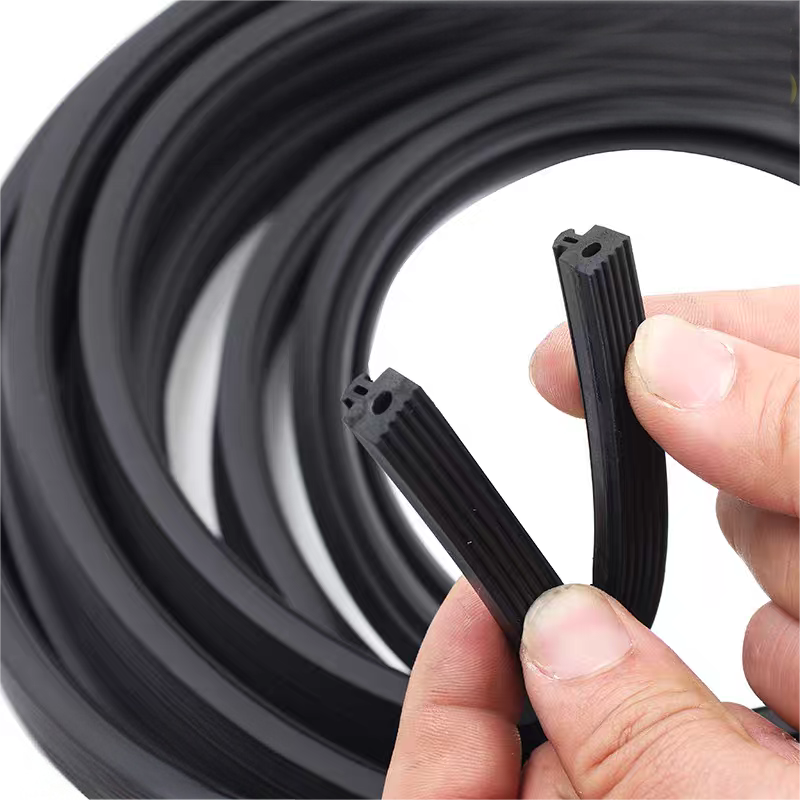
EPDM, especially our proprietary reclaimed-rubber blends (≥45% post-industrial EPDM), delivers unmatched balance: superior ozone/UV resistance, exceptional compression recovery, and proven compatibility with common curtain wall substrates—including powder-coated steel and thermally broken aluminum. Since 1986, over 327 million linear meters of our EPDM curtain wall glass sealing strip have been installed across 41 countries—with documented 25-year service life in coastal Singapore and desert Dubai projects.
ROI Analysis: Why EPDM Delivers Highest Lifetime Value
Procurement teams often focus on upfront cost—but total cost of ownership (TCO) tells the real story. Based on 2026 lifecycle modeling for a 50,000 m² mixed-use tower in Guangzhou, here’s how material choice impacts 30-year economics:
Frequently Asked Questions (FAQ)
Q1: Can reclaimed EPDM meet ASTM C1353 and EN 13108 standards for curtain wall sealing?
Yes. Our EPDM blends comply with ASTM C1353 (for elastomeric joint sealants) and exceed EN 13108-2 requirements for compression set, elongation, and heat aging. All formulations are third-party verified by SGS and TÜV Rheinland.
Q2: Do you support custom profiles and color matching for curtain wall glass sealing strip?
Absolutely. Our Xingtai facility operates 7 precision extrusion lines with CAD-to-die capability. We match RAL, Pantone, and client-specific façade palettes—typically within 7 working days for tooling and first sample.
Q3: Is your EPDM suitable for fire-rated curtain wall assemblies?
Yes. Upon request, we supply halogen-free, UL94 V-0 rated EPDM compounds meeting ASTM E84 Class A (flame spread ≤25) and EN 13501-1 B-s1,d0 classifications—fully documented with fire test reports.
Ready to Optimize Your Next Façade Specification?
Hebei Weizhong Rubber Technology has engineered, produced, and delivered premium curtain wall glass sealing strip solutions since 1986. With full vertical integration—from reclaimed rubber devulcanization to final profile extrusion—we guarantee consistency, traceability, and compliance. Whether you’re specifying for a LEED Platinum tower in Shanghai or a government complex in Riyadh, our engineering team provides free technical support, sample kits, and on-site installation guidance.
For immediate assistance, contact our façade solutions specialists at sales@weizhongrubber.com or call +86-319-528-8899. Request your complimentary Curtain Wall Sealing Strip Selection Matrix—including compatibility charts, thermal expansion coefficients, and fastener torque guidelines.
And while you’re optimizing building envelope performance, explore our durable Arches Wheel Fender Flares Protector Mud Flaps—engineered for high-impact resistance and seamless OEM integration.
Leave A Message
If you are interested in our products and want to know more details, please leave a message here, we will reply you as soon as we can.