




Uneven cells in rubber foaming can leave an extruded profile with a rough surface, inconsistent density, and dimensions that drift after cooling. For the operator, the frustrating part is that several different problems can produce a similar-looking defect. A coarse cell may come from poor dispersion, premature gas release, insufficient compound strength, or an uneven heating pattern.
Before changing the blowing-agent dosage or raising the oven temperature, establish where the variation begins. A useful investigation follows the material from the mixed batch through extrusion, expansion, curing, and cooling. The aim is to separate material variation from line instability—and avoid correcting one problem by creating another.
Read the cell pattern before adjusting the line
Keep a sample from a stable production run beside the defective profile. Compare sections cut at the same location, after the same cooling interval, using a sharp blade that does not crush the foam. Inspect several sections along the extrusion rather than relying on one piece.
Record whether the defect is across the entire section, limited to one side, concentrated in thick areas, or repeated along the length. These patterns offer direction, although none proves a cause on its own.
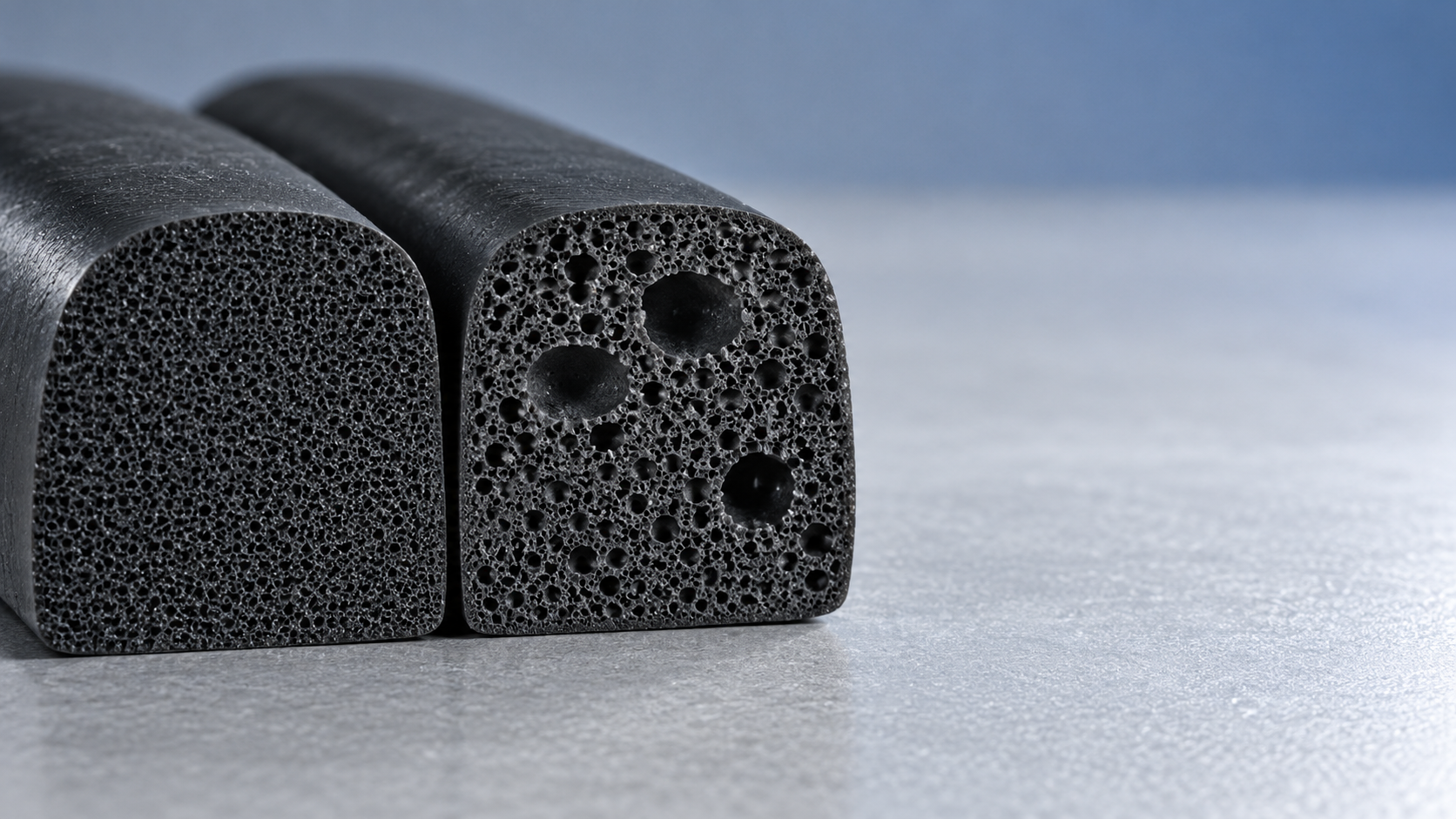
Also note when the problem appears: immediately after startup, after a speed change, following a compound-batch change, or only after extended running. That timeline can be more revealing than the defect itself.
Check compound uniformity before blaming foaming temperature
A stable extruder cannot make a uniform cellular structure from an inconsistent compound. Review the batch identification, mixing record, storage conditions, and time between mixing and extrusion. Compare these with the last acceptable run.
Dispersion is a practical starting point. Agglomerated blowing agent can create localized gas-rich areas. Poorly distributed fillers, curatives, or processing aids can also produce differences in viscosity and cure response. Where available, use established dispersion checks and laboratory tests rather than judging only the compound surface.
- Confirm that the correct blowing-agent grade and dosage were weighed.
- Check the addition sequence and mixing conditions against the approved procedure.
- Review discharge temperature and subsequent warming for possible premature reactions.
- Inspect for contamination, damp ingredients, and unintended changes in rework addition.
- Check whether feed strips are consistent enough to avoid alternating starvation and overfeeding.
Do not automatically lengthen mixing time. Additional mixing may improve distribution, but it also adds heat and can reduce processing safety. Any change should stay within the compound’s validated mixing window.
Where EPDM reclaimed rubber enters the diagnosis
EPDM reclaimed rubber should be treated as a controlled formulation ingredient, not simply a replacement weight. Its viscosity, residual crosslinked fraction, filler and oil content, and compatibility with the remaining compound can affect flow, expansion resistance, and cure behavior.
If uneven cells appear after changing the reclaimed-rubber lot or loading, compare compound viscosity, scorch safety, cure response, and finished density under the same test conditions. A change in overall compound balance may require formulation review; adjusting the oven alone may only hide the symptoms temporarily.
Hebei Weizhong Rubber Technology has specialized in EPDM reclaimed rubber research, production, and sales since 1986. When discussing a material-related issue with the supplier, provide the loading level, compound test results, processing conditions, and defective cross-sections. These details support a more useful material assessment than a general request for “better foaming.”
Measure actual conditions—not just displayed settings
A barrel or die setpoint does not necessarily represent the rubber’s actual temperature. Shear, screw speed, backpressure, residence time, and interruptions can all change the heat history of the compound.
Review actual temperature readings alongside screw speed, motor load, head pressure where monitored, and output. Use approved measurement methods and follow guarding and lockout procedures; never reach into running equipment to obtain a sample or reading.
If pressure and output fluctuate together, investigate feed delivery and extrusion stability before adjusting downstream heat. Check feed-strip dimensions, hopper behavior, screw condition, and possible restrictions according to the line’s maintenance procedures. Repeated surging changes both material delivery and thermal history, which can appear as alternating cell structures along the profile.
During an authorized shutdown, inspect the die and flow path for deposits, damage, or partial blockage. Persistent differences between opposite sides of a profile may involve flow imbalance as well as heating. Increasing overall temperature will not necessarily correct either one.
Foaming and curing must develop together
Uniform rubber foam depends on a workable balance: gas must expand the compound while the developing rubber network provides enough strength to retain the cells. The objective is not simply maximum gas production or the fastest cure.
If significant gas generation occurs while the compound is too weak, cells may grow excessively, merge, or collapse. If the network becomes restrictive too early, expansion may be limited and the profile may remain too dense. Uneven temperature through the section can produce both conditions in different regions of the same extrusion.
Check the blowing-agent supplier’s technical guidance alongside the compound’s cure data. Decomposition behavior depends on the agent and formulation, including activators; it should not be inferred from oven temperature alone. Laboratory cure measurements help assess reaction timing, but they do not fully reproduce heat transfer through a moving profile.
For a continuous curing line, review:
- Line speed and residence time: a speed change alters the time available for both expansion and cure.
- Heating distribution: verify zone performance, airflow, and any microwave settings used by the process.
- Profile position: contact with supports or a changed orientation can alter local heating and deformation.
- Section thickness: thin lips and heavy sections may reach reaction temperatures at different times.
For shaped sealing applications such as an S-shaped Automobile windshield seal strip, dimensional balance matters alongside cell appearance. Where a cellular construction is specified, a visually acceptable section can still be unsuitable if uneven expansion distorts the sealing geometry.
Check whether cooling is exposing a hidden weakness
A profile that looks acceptable at the curing-line exit but shrinks later needs a different investigation from one that is visibly uneven as it expands. Compare dimensions and density only after a defined cooling and conditioning period.
Review cooling uniformity, haul-off tension, and support through the downstream section. Excessive tension can stretch a warm profile; uneven support can deform it before its structure stabilizes. Continued shrinkage or collapse may indicate inadequate cure or weak cell walls rather than a cooling problem alone.
Run a controlled trial instead of chasing settings
Once the likely cause is narrowed down, change one variable at a time within approved operating limits. Record the batch, actual process readings, line speed, adjustment, and sample time. Allow the previous material to clear and the line to stabilize before judging the result.
Assess the trial against consistent criteria: cell distribution across the section, conditioned density, dimensions, surface quality, and any required sealing or compression performance. A finer-looking foam is not an improvement if it fails the application.
Keep the successful settings together with the material and test records. The most reliable correction is one the next shift can reproduce—not one that depends on repeatedly turning up the heat until the profile looks right.
Leave A Message
If you are interested in our products and want to know more details, please leave a message here, we will reply you as soon as we can.